The Feather Thief. Kirk Wallace Johnson 2018, 248 pages.
If there was ever a need to defend the old adage that truth is stranger than fiction, this book would provide definitive proof. As the convicted thief told the author in an interview “You can’t make this stuff up.” It is the real-life bizarre story of a 2009 break-in at the British Museum of Natural History to steal bird skins and feathers. Furthermore the thief was a talented aspiring young American musician at the Royal Academy of Music in London. And the story may never have been told in any detail were it not for an off-hand comment by a fly fishing enthusiast waist-deep in a California river, to a stressed-out ex-soldier and refugee advocate.
Johnson details the history of collecting specimens of animals and birds from all over the world for museums and private collections from the time of Wallace and Darwin in the mid 1800s to the multimillion dollar market for feathers in the fashion industry in the late 1800s to the present black market in endangered species. Only in the early 1900s did the Audubon Society and similar conservation groups begin to pressure governments to restrict the trade in exotic feathers and furs. Unfortunately my favourite pastime of tying flies and fly fishing has got a bad reputation in this field with expert tiers of Victorian-era salmon flies spending thousands of dollars for skins of endangered Resplendent Quetsal, Indian Crow, Flame Bowerbird, Bird of Paradise, Blue Chatterer, and Jungle cock, and openly trading them on eBay in defiance of the Convention on International Trade in Endangered Species. You can still watch U-Tube videos of many of them demonstrating how to tie the exotic feathers on to a hook. And they are like a secret society clamming up when asked about the missing museum specimens and the origin of some of their materials.
Walter Rothschild’s Museum of Natural History in Tring, England houses close to 700,00 bird skins and 17,000 whole birds from around the world, of enormous value to scientists. The thief (or thieves, since it is still not clear whether or not he acted alone) stole close to 300 of these in one night, for the express purpose of satisfying his obsession with flies for fishing. His crime was not solved for fourteen months and he was then given a light sentence because of an almost certainly false claim by his lawyer that he had a controversial psychiatric disorder.
I have been a member of two different fly fishing clubs and have been to a few fly fishing conventions and watched some professional tiers in awe of their skills. But the Victorian salmon flies that often are featured in tying contests (and are the ones most likely to require feathers of exotic birds) bear little resemblance to the salmon flies amateurs like me are likely to tie. They are art forms that may take hours to tie and are far too expensive to ever risk losing in a stream-side tree. Amateurs like me are more likely to use cheap but practical materials, often not from the tackle shops at all. If you spot someone plucking feathers or clipping fur from the roadkill, you can be sure he or she is an amateur fly tier. A friend recently called to tell me that he had shot a deer and asked me if I wanted a piece of tail! I declined.
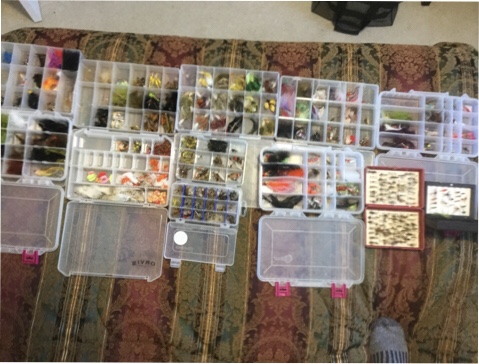
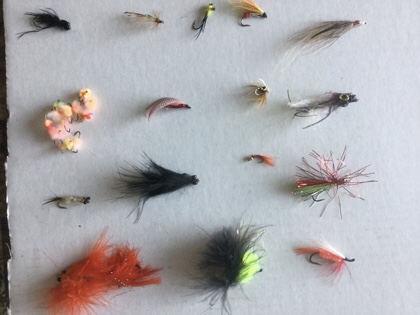
On reading this book, I recalled one incident that seemed strange at the time but now makes sense. About the time of the feather theft, I crossed the border from Sarina to Port Huron on my way to our annual week of salmon fly fishing in a remote secret site in northern Ontario. I was the designated fly tier for the dozen or so men in our camp, and had perhaps 400 flies in boxes and trays in my vehicle. (A few of my creations in boxes and a closer look at a few are shown below). Quite proud of myself for figuring out how to import these photos). The border booth guy asked me what was in the boxes, asked to see them, then asked if any of the flies were made from the fur or feathers of endangered species. He seemed satisfied when I told him that I got all of the material from reputable tackle shops. I realize now that I did have several flies with jungle cock cheeks.
This story was recently topped in weirdness by a story of seventy live Guyanese finches, worth up to $10,00 each, seized by customs agents at Kennedy Airport, hidden in hair rollers. They were supposedly destined for illegal singing contests, and were kept quiet for their flight by being given rum.
I might be accused of a bias because of my hobby, but I highly recommend this well-written stranger-than-fiction story.

 The Passionate Reader