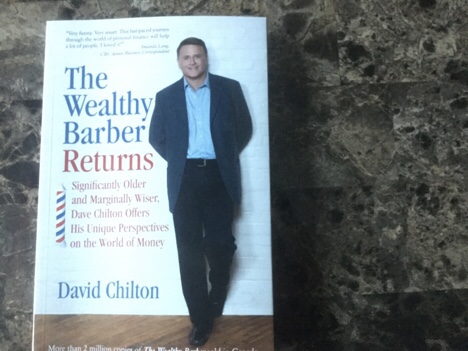
The Wealthy Barber was a rather unexpected hit for this Ontario financial guru when it was published in 1989. This follow up volume combines his unique corny wit with somewhat updated financial advice to Canadians regarding personal financial planning. Although even this book is now a bit out of date, and the wealthy Barber featured in the first book does not appear at all in this volume, he provided little newer advice in a sponsored public lecture we attended last week. (His oratory is not as good as his writing, with staccato rapid-fire speech that can be hard to follow, overly flamboyant gesticulations, and some self-deprecating humour that becomes a bit boring). He seems, both in his writing and his lectures, to have succeeded in resisting the Veblen effect that I discussed last week, in the review of The Theory Of The Leisure Class. Conspicuous consumption and conspicuous waste, merely for the purpose of ‘keeping up with the Joneses’ has apparently never been his weakness, nor is it mine, or so I like to think. But he or his publisher waste a lot of paper, with thirty two blank verso pages between chapters and even more blank lines between paragraphs, presumably to make the book seem longer than it is. How many trees should he plant to atone for this conspicuous waste?
But he is brilliant and here largely avoids the technical arcana and acronyms that permeate most writing about the world of finance. His advice about investment and saving for people at different stages of life is hard to fault and is backed up by carefully explained logic. Unlike many self-styled financial gurus, he acknowledges uncertainty where appropriate, such as when considering whether to put savings into an RRSP or a TFSA, and exposes the near impossibility of beating the market averages with frequent self-directed stock pickings. (If you insist on buying and selling stocks via your home computer, you should probably consider it as a hobby, like playing Texas Holdem poker, rather than as a plan for financial security.)
Like everyone, he undoubtedly has biases, some acknowledged, some probably unconscious. His strong recommendation to employ professionals rather than trusted relatives as trustees and executors of wills seems to me to be a blatant unacknowledged promo for the professional organizations who, after all, finance his many speaking trips around the country. Full disclosure, anyone?
This book is a valuable resource for Canadians who, like me, cannot make a priority of taking the time to deeply delve into personal financial planning-almost anything else is more appealing to me. But finding an experienced and communicative financial advisor whom you trust, and then following his or her advice is probably more valuable than slavishly following Chilton’s advice, as good as it is.

 The Passionate Reader