I can claim some connection to both books that I review this week, having met the author of of one and the title hero of the other one on different social occasions.
Muslim Women Speak. Amani Hamdan. 2009. 196 pages
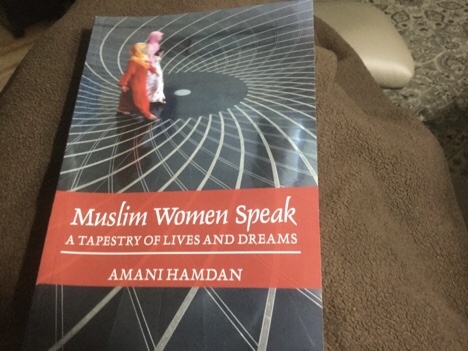
My autographed copy of this peculiar book was sent to me via a mutual friend, by the author, the wife of one of our several stellar Saudi trainees in hepatology in the 1990s. I doubt that I can provide a review of it without offending someone, but I will try to set aside my personal biases and stereotyping, and give it an honest try. For a book with this title, it seems peculiar that Hamdan, who lived in Ottawa at the time of this writing, never once mentions her husband who was then serving in the Saudi military, nor her children. She has since returned to an academic career in Damman, Saudi Arabia. I suspect that there was some self, if not political, censorship of what she wrote, given her plans to return to Saudi Arabia. I wish her well in her career there.
When in London with her young family, as her husband trained with our team, Hamada advertised for Muslim women at Western University to answer a questionnaire and be interviewed about their beliefs and attitudes about women’s roles in society, their education, their experiences in their native Arabian countries and in Canada, and the role of their religious faith in their lives. All nine who were selected were immigrants, all were Sunni, and all were urban and highly educated. As such, they can hardly be thought of as representative of the broad category of Muslim women, although they had come from various Mideast countries. And all were devout unquestioning Muslims.
The results revealed in this book divulge a diversity of beliefs, hopes, and aspirations. Several refused to acknowledge any inherent misogyny in the Muslim faith, claiming that the Quran and the Hadith empower women. But it is a low moral bar to point out that the Quran bans the once widespread practice of burying young girls alive, and I doubt that any objective data-based study could conclude that women are granted equal opportunities to men in any Muslim-majority state. And it does little to help in this effort to argue that the restrictions are cultural rather than religious, as Arab culture and the Muslim faith seem inexplicably intertwined. ‘The lady doth protest too much, methinks.’ But Islam is not alone in denying women opportunities open to men, witness, for example, the Roman Catholic Church.
None of them, even those professionals in scientific fields ever question the restrictions on their activities that their faith requires. How restrictive life must be to be obliged to pray five times daily, segregate yourself from all males at worship and and never socialize or even be seen with a man who is not a close family member, do all the cooking but never do the grocery shopping without dragging a reluctant close male relative along?
The participants contrast educational styles in their native societies and in Canada with the former uniformly emphasizing rote memorization (especially of the Quran) and the latter stressing independent rational thinking and problem solving. Perhaps one result of their rigid early education is fixed brain wiring that makes later questioning of their faith difficult or impossible. But then again, are we all restricted in our thinking by brain synapses developed early in our lives?
Although the author describes this as research, and dresses it up with notes at the end of each chapter, seventeen pages of references, and thirty pages of appendices, there is no way this collection of opinions should be considered as anything approaching valid science. There is absolutely no data. The best I can say about it is that I learned a modest amount about the lives of some Muslim women in Canadian cities, and developed a deeper understanding of their struggles.
Thanks, Amani and Cheryl.
The Man Behind The Marathons. Elaine Cougler 2019, 159 pages.
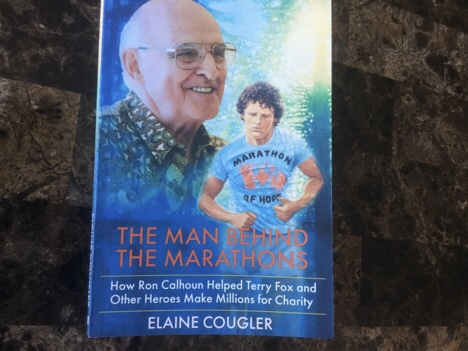
This laudatory biography of a remarkable London, Ontario area man was a joy to read, not only because I have met him and his daughter and son-in-law are dear friends, but because of the contagious inspiration of the now elderly man’s many accomplishments. Ron Calhoun was never a rich man, but gave what he could give-his time and considerable organizational talents- for the betterment of all Canadians. The Terry Fox Marathon of Hope for the Canadian Cancer Society, the Steve Fonyo run across the country for the Cancer Society, the Ken McColm run for the Canadian Diabetes Association, Jesse’s Journey for Duchenne muscular dystrophy and dozens of other worthy fundraising events would never have occurred at all or would have failed were it not for the dedication and hard work of Ron Calhoun’s determination to make the world around him a better place.
The first 110 pages detail the contributions, trials, and problem-solving skills that Ron Calhoun brought to those charity events, while Part lll provides an insider’s insight into what drove this tireless, humble man. The writing style is straightforward and factual narrative. I knew dozens of the people who interacted to help Ron in his endeavours and greatly enjoyed re-visualizing many of the familiar places in and around London and across the country. But I was too naive to know what those individuals were up to in their work with Ron until I read this book.
We live within a mile of Terry Fox Drive, and my six-year old grandson heard about the Terry Fox Marathon of Hope in Grade1, and participated in a school Terry Fox run. He loves stories about Terry; I am looking forward to reading this book with him and discussing it with him.
As Vera commented, If you want a definition of altruism, just think of Ron Calhoun.
Thanks, Lori, Ken, and Vera.

 The Passionate Reader