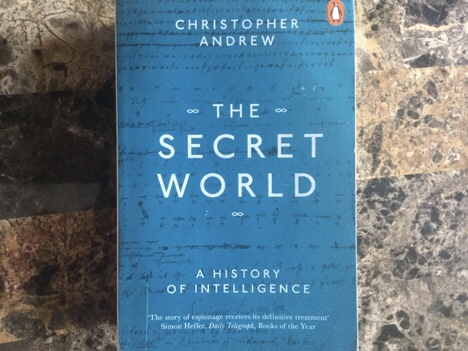
I struggled through the first 250 pages of this Cambridge professor’s tome on espionage, counter-espionage, double agents, and military intelligence and was only up to the mid 1660s. I was ambivalent about continuing, but some of the later chapters looked interesting. The Ottawa Public Library made my decision easy by informing me that it was due, and could not be renewed as there were five ‘holds’ waiting for it.
What new information did I glean so far?
1) The classic military text The Art of War was probably not written by Sun Tzo, or any one individual.
2) Water boarding as a technique to squeeze information from captured enemies was not invented by Donald Rumsfeld’s sadists, but by the religious zealots of the Spanish Inquisition.
3) King Philip IV of Spain used Catholic Dutch-Flemish painter Peter Paul Ruebens as a go-between to obtain inside information from the English court of Charles I; by flattering the vain English king while painting his portrait, he secretly obtained information about the English intentions, during the Thirty Years War.
4) Richard Bissel’s bungled enlisting of the Mafia in an attempt to assassinate Fidel Castro is widely used as a classic example of the failure of military intelligence, not apparently as an example of any moral failure. (This information seems out of place in the otherwise chronological discussion.)
The chapter Renaissance Venice and Western Intelligence meanders through various European courts to Cortez and Pizarro in a disjointed discussion of the importance of decryption and spying interspersed with descriptions of incredibly cruel means of extracting information about the enemy intentions, during the Thirty Years War. I am left with the impression that being a royal during the 1600s was an inherently risky occupation, and can never remember who was allied with who in the constantly shifting borders and allegiances of Medieval Europe.
I may at some point return to this book to selectively read some of the later chapters on intelligence, e.g. weapons of mass destruction in Iraq, then again, I may not. Probably a great resource for serious historians, military strategists, foreign service agents, and for anyone feeling the need to spew obscure true historical anecdotes at a cocktail party.

 The Passionate Reader