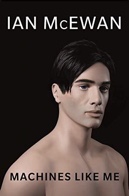
Alan Turing works on Artificial Intelligence in his lab in 1983 even though he committed suicide in 1957. In the same year, Britain loses the Falklands War to Argentina, with heavy losses, Margaret Thatcher’s government loses the election to the Labor Party, Jimmy Carter begins his second term as U.S. president, having defeated Ronald Reagan, British electric cars go 1000 miles on a single charge, and the first person singular narrator of this sci-fi tale reads the news on his iPhone. A computer company has developed and sold 25 programmable humanoid companions that pass for true humans, spouting poetry, with greater memory capacity than the usual human, and conversing with their owners. These obvious deliberate distortions of history must serve some deep literary or philosophical purpose that is far from clear to me. Why is the possibility of beings developed in computer labs that rival Homo sapiens not set at some future time with truly fictional characters? Perhaps the author wishes to convey the ideas that in some sense Alan Turing is still alive and that history is largely a fiction that we are forced to believe because of our limited intelligence? I am just guessing.
I read this book as an ebook, borrowed from the library, because it is on the agenda for my book club. The characters are realistic and there are enough surprising plot twists to keep me intrigued.
A couple good quotes: “But a mood could be a roll of the dice. Chemical roulette. Free will demolished, and I was here feeling free.”
Alan Turing describing the human brain. “A one-litre liquid-cooled three-dimensional computer. Unbelievable processing power, unbelievably compressed, unbelievable energy efficiency, no over-heating.The whole thing running on twenty-five watts-one dim lightbulb.”
I generally dislike sci-fi, but for fans of the genre this will be a gem and it is now being presented as a television serial. And I can accept that beings created in labs from Artificial Intelligence algorithms may at some future point pose a threat to the earthly supremacy of our species, but not in my lifespan. I still prefer McEwan’s Saturday.
Thanks, Din.

 The Passionate Reader