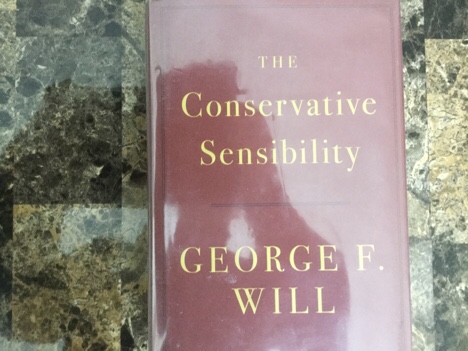
As soon as I noticed that this political tome was dedicated to the memory of Barry Goldwater, I realized that I would have difficulty overcoming my biases and keeping an open mind about its contents. But I’ll try to give it an honest review.
George F. Will is the elder doyen of American Conservatism, at least as he defines it, an Oxford and Princeton graduate, a Pulitzer Prize winner and, a syndicated columnist for The Washington Post, once owned by Rupert Murdock, now by Jeff Bezos. This, his fifteenth book, is the only one I have read.
First the positives.
1) There is much to admire in the clarity which Will brings to the differences between what he calls conservatism and progressivism in conceptions of the proper role of government in a free society. Based on his almost worshipful admiration for the Founding Fathers, the Declaration of Independence and the American Constitution as the unerring literal last words on how to organize a democratic society, he makes a very strong case for a minimally interventionist small government that exists only to protect the rights and liberties of individual citizens. He sees those rights and liberties as innate unchanging features of human nature rather than being granted by a government.
2) The whole book is chock full of interesting historical anecdotes and facts, e.g. Hitler was not an ethnic German (Austrian), Napoleon was not French (Italian), and Stalin was not Russian (Georgian). There are many counterintuitive perspectives that are difficult to disagree with.
3) After heaping supreme praise on the founding documents, Will fills hundreds of pages documenting the many problems with American government and society as it has evolved since. His ridicule of regulatory capture by rent-seeking special interest groups, the abdication of responsibility of Congress to the executive branch, the explosive growth of self-serving bureaucracies, and judicial failure to rein in creeping central government restrictions of citizens’ liberties as defined in the Founding Documents – these are all spot on. Why should government dictate the price of pressing men’s pants, or restrict the right of anyone to become a flower arranger? The best summary of his complaints is this quote: “Government power is increasingly concentrated in Washington. Washington power is increasingly concentrated in the executive branch, and executive power is increasingly concentrated in agencies that are unconstrained by legislative control.”
4) The deep philosophical musings in the chapter Welcoming Whirl on the role of religions and modern sciences in a democratic society is respectful of differing beliefs, detailed, interesting and thought-provoking. The conclusion that it is not essential to believe a religious creed to be moral and to be awed by nature is one I have come to accept as a card-carrying humanist. In discussing neuroscience, Will skids close to denial of the existence of free will. Pardon the pun.
Obviously, Will is very knowledgeable in the fields of political science, history, economics and philosophy (there is a 37 page introduction, a 19 page “Selected Bibliography”, 23 pages of Notes, and a 15 page Index, not included in the page number I noted above). Few others have such extensive experience and knowledge in this field, leaving little room for counterarguments unless one refuses to accept his basic unstated assumptions about human nature, the wisdom of the Declaration Of Independence and the Constitution, and the unique virtue of American exceptionalism, as I do.
Now the negatives.
1) The writing is humourless, dry, and pedantic, with many examples of distinctions without a difference, (one of the author’s favourite phrases), and the reasoning often seems convoluted, though to be fair, the factual knowledge is encyclopedic in its scope.
2) Both the underlying assumption that human nature is immutably fixed and that this confers natural rights to liberty and the pursuit of happiness are untestable philosophical assertions that are suspect. I doubt that the historian/philosopher Yuval Noah Harari (Sapiens) would concur with the former assertion, nor the political scientist Francis Fukuyama (The Origins of Political Order) with the latter. My “human nature” has nothing in common with that of concubines who willingly were buried alive with their Chinese emperor.
3) The much lauded statement that all men are created equal is one of the silliest assertions ever enshrined in an historical document, very different from the indisputable moral assertion that all men (and women) should be granted equal rights and privileges. The Founding Fathers obviously didn’t put into practice their assertion of inalienable equal rights when it came to blacks, women and Natives whom they slaughtered with abandon. Will seems to excuse this as an example of “presentism”- the application of today’s moral standards to previous generations.
4)The American boosterism becomes grating. Will describes the second paragraph of their Declaration of Independence as “ the most important paragraph in humanity’s political history.” What makes it more important than parts of the Magna Carta?
“[Americans] correctly believe that its political arrangements, its universal truths and the understanding of the human condition that those arrangements reflect are superior to other nations’ arrangements.”
“America, the first and most relentlessly modern nation….”.
5) If the pursuit of happiness is, as asserted, a uniquely American goal, why is America ranked #19 out of 156 countries in the well-validated 2019 U.N. Index of National Happiness, behind all the socialist Nordic countries, Canada (#9), and Costa Rica (#12)?
6) There are several simple factual errors. America is not the only country with an exact date of origin, as asserted. Humans are not the only species who can experience melancholy, and/or boredom, as any dog owner can attest.
7) Although written, or at least published, in 2019, the name Trump is never mentioned and there is no discussion of the role of American conservatism in the rise to dictatorial power of this rogue Constitution-ignoring egotist, though in an interview with Peter Wehner in The Atlantic, (July, 2019), Will thoroughly castigates Trump. I think it must have been that review that persuaded me to slog through this book, as no true friend recommend it to me.
I see that I have listed more negatives than positives-perhaps not fair as I did gain a lot of insight into the mindset of American conservatives from this book. But it is not for everyone and if you are a liberal minded non-American with high blood pressure, reading it could be lethal.

 The Passionate Reader