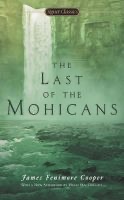
If this old classic novel, first published in 1826, had not been on the agenda for my book club, I would probably never have picked it up, and certainly would not have slogged through it to the end. Set in what is now upstate New York, it centres on the seemingly endless and barbaric battles between different Indian tribes, the French interlopers from the North, led by Montcalm, and the British and Dutch pioneers trying to bring civilization as they understood it, to the frontier, during what was known as the French and Indian War.
There are many editions and adaptations of this. I read the Penguin paperback edition of 1962. I found it confusing and wordy with all the literary flourishes and long descriptions of the scenery and characters typical of writers of that era. Why use a few words to convey an image to the reader when long convoluted descriptions of nonsense can be deployed as in this quote: “The solitary and arid blades of grass arose from the passing gusts fearfully perceptible: the bold and rocky mountains were too distinct in their barrenness, and the eye even sought relief in vain, by attempting to pierce the void of heaven which was shut to its gaze by the dusky sheet of ragged and driving vapour.”
A modern publisher would do readers a big favour to include a map of the settings and a list of the main characters with their numerous aliases. As I struggled to keep the characters straight and to recall whom was allied with whom, I wondered if others had greater mental capacities to retain and organize the complexity of the plot. If this story was meant to be allegorical or metaphorical, that interpretation was totally lost on me.
There are various very unrealistic twists to the plot including warriors disguised as a bear or a beaver being able to deceive the very perceptive natives. The dead and the slightly wounded warriors are described in detail, but no one seems to be severely wounded in battle but still alive, a more common outcome of almost all wars.
I eagerly await enlightenment from the book club member who recommended this book, but cannot myself recommend it to anyone.
The one dubious merit of this story is that it unapologetically, and in great detail, depicts the bigotry of a wealthy misogynistic privileged early 17th century white male American settler with a town named after him. Hurons, Iroquois, Delaware’s and all the other natives are uniformly shown as war-mongering scalpers. Women are shown as feeble-minded creatures of beauty to be coveted only for their ability to produce future warriors.

 The Passionate Reader