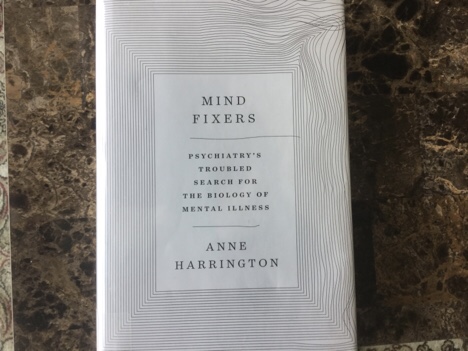
This new history book, the second of my peeks into the murky world of psychiatry in a week, is written by a professor of the history of science at Harvard. With 77 pages of notes and a 22 page index, it is certainly scholarly. As the subtitle suggests, it is also a story of failures, false hopes, and a divided and dysfunctional profession at war with itself, right up to the present.
There is an abundance of historical detail, much of it not at all flattering to the professionals who like to consider themselves as being guided by scientific principles. Charlatans, egotists, and mercenaries seem to find comfortable niches for themselves in the world of mental health care. Egan Moniz’s 1949 Nobel prize for pioneering lobotomy in 1949 is still an embarrassment to the whole profession. Other equally unscientific and ethically dubious treatments such as electroconvulsive therapy, insulin shock therapy, hormone ‘conversion’ therapy for homosexuality, and involuntary sterilization of institutionalized schizophrenics, persisted long past the era when other branches of medicine had embraced at least basic scientific principles in research. In the 1960s an influential dissident psychiatrist, Thomas Szasz, aligned his movement with the distinctly nonscientific dianetics practices of L. Ron Hubbard’s Church Of Scientology.
The conflict between the Freudian psychoanalysts and the biological-oriented researchers who hoped to find an anatomical or biochemically basis for mental illnesses continues, with the repeated failures of the latter, including the glaring inconsistencies of the heavily marketed “chemical imbalance” theories promoted by pharmaceutical companies to promote sales of various antipsychotics and antidepressants that are only marginally more effective than placebos. Blind faith in pet theories led the Canadian psychiatrist Humphrey Osmond at the Weyburn Psychiatric Hospital to the false claim to have found the mediator of psychosis (adrenochrome), and to treatment of ‘cerebral pellagra’ with megadoses of niacin. His experiments with LSD along with Aldous Huxley, Timothy O’Leary and Alan Ginsberg, then led them to deny the existence of psychosis as an illness.
Many of the drugs discussed, from chlorpromazine to all the modern antidepressants and ‘atypical antipsychotics’ were familiar names to me from my days living in the now defunct London Psychiatric Hospital and in a medical practice that included a wide range of mentally ill patients. But their route to discovery as carefully detailed here were not as familiar. Among the most unlikely of those routes is the serendipitous discovery of lithium carbonate, once an ingredient in 7-Up, as an effective treatment for bipolar disorder. With the expansion of the number of mental illnesses in the DSM-5, (what is “Disruptive mood dysregulation Disorder?) it seems anyone can qualify for some psychiatric label, even as big pharmaceutical companies abandon attempts to find new treatments, frustrated by the stringent requirements for demonstrating safety and efficacy imposed by regulators.
The decline in institutional care of the mentally ill in the 1980s left the care of many needy patients to inadequately funded community centres, families, and prison guards.
One minor editorial quibble. “(See Chapter 4)” is in the middle of Chapter 4.
This is a comprehensive and engaging, but somewhat depressing history that should interest anyone dealing with mental health issues themselves or in relatives or working in the field, which probably includes just about everyone. But my take on it may be biased- no one has ever accused me of being sane.

 The Passionate Reader