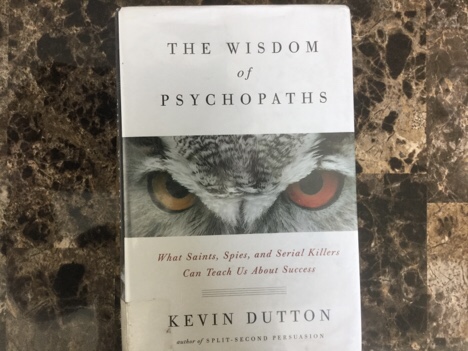
All the usual tropes of modern psychology are here including the Stanford prison experiment, the runaway trolley car thought experiment, and numerous studies dreamed up by psychology professors, often using their students as research subjects. Perhaps I have read about these too many times to be impressed, but there was enough intriguingly different about some of the findings and speculations here to keep me interested, and the title alone is enticing. And I have dealt with enough criminal psychopaths in my professional past to keep me interested in the field.
I have to relate one such encounter. A itinerant, very charming man flagrantly flirted with my secretary at each appointment. He had never kept a job for more than a few months and had a long rap sheet but called to cancel a followup appointment, telling my secretary that he would call back to rebook. The next morning, while listening to the six a.m. news, I recognized his name. There was a Canada-wide warrant out for his arrest!
The whole concept of psychopathy and personality disorders is a twentieth century phenomenon, driven by psychiatry’s need to categorize and fit personality types into arbitrary slots. But many studies have shown that the tools such as the Hare Psychopathy Checklist-Revised, the Psychopathy Personality Inventory and the Levenson Self-report Psychopathy scale do quantify personality traits along a continuum. That continuum can then be arbitrarily chopped into categories to facilitate social science studies, treatment trials, and research.
Dutton documents the counterintuitive fact that many, and perhaps most psychopaths, are not ruthless serial killers or rapists but are high functioning societal and business leaders, military heroes, religious leaders, and political operatives. He discusses the probability that Jesus, St. Paul, Steve Jobs, almost all military special unit members and the fictional James Bond would score in the psychopathic range if the modern tests could have been applied to them. Their shared traits of fearlessness, charisma, nonconformity to societal norms, narcissism, short term perspective, assertiveness, and lack of remorse can be useful traits for everyone- in small doses. I would include persuasive salespeople- I once knew a teen who sold a Greenpeace membership to a guy sitting in a Hummer.
The neurological basis for psychopathy is discussed with documented genetic contributions and fixed anatomical brain differences between control and psychopathic subjects. The most interesting revelation is that it is possible, in a laboratory, to temporarily produce the mental and physiologic characteristics of a psychopath in normal individuals using carefully focused transcranial magnetic stimulation, as convincingly documented by applying this technique to the author.
Without exception, all the psychopaths studied or discussed were male, but there is no discussion of any possible reasons for the male predominance. Where are the Karla Homolkas and Terri-Lynn McClintics of the world. Granted, they were accomplices of male psychopaths.
A great quote from an institutionalized criminal psychopath: “But what if you don’t need courage? What then? If you don’t have fear to start with, you don’t need courage to overcome it, do you?”
For fun, I took the online revised Hare Psychopathy Checklist and completed the answers to the Levenson Self-Report Psychopathy scale. I think it would be very easy to game these questionnaires to come up with any conclusion you wanted, but I answered honestly. Seems I failed both if the aim is to self-diagnose psychopathy, but the latter concluded that I was at 60% on the scale for a “general personality disorder.” As they are in the business of selling counselling services, I don’t take their ratings very seriously.
This book was interesting, but not essential reading unless you work in the mental health field, or have developed serial killer instincts during your corona virus quarantine.

 The Passionate Reader