Where to start? Perhaps with a relevant confession. During my professional career, now rapidly receding from memory, I enjoyed and benefitted from the largess of several pharmaceutical companies, including trips to sponsored conferences in sunny climes, free lunches, and honoraria for lectures, work on clinical trials, etc. I naively convinced myself that none of the freebies influenced my prescribing decisions, and viewed, albeit somewhat sceptically, the information provided by reps, as education I would otherwise never get.
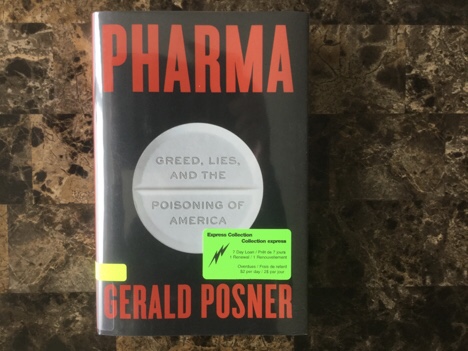
This exhaustively researched detailed assessment of America’s pharmaceutical industry by a topnotch freelance investigative reporter is not an easy read. There is a 32 page Selected Bibliography, 89 pages of Notes, and a 37 page Index, as well small-print footnotes on almost half of the pages. It is arranged chronologically from the early days of the nation when coffee was considered more dangerous than freely-available cocaine and opiates, to late 2019 when Perdue Pharma chose bankruptcy rather than further government investigation into their criminal responsibility in the opioid overdose crisis. In between, there are hundreds of revelations about an industry that hoodwinked various underfunded and understaffed federal agencies, broke laws, deceived the public and became the fastest growing industry in the country. There is background information on the development of hundreds of drugs I knew by name and at least a dozen companies I interacted with.
Among the more interesting revelations.
While setting up his President’s Advisory Commission on Narcotic and Drug Abuse, John F. Kennedy was daily downing eight different medications including two different narcotics, a barbiturate, Librium, and an amphetamine.
The Reagan government downsizing led to the FDA accepting pharmaceutical company data without fact-checking or field investigations. Annually, the Sackler family, of later Perdue-OxyContin fame, paid the head of the FDA several times his yearly salary in ‘honoraria’.
Several pharmaceuticals companies knowingly sold contaminated blood products pooled from paid, often criminal donors. The hospitals, clinics and foreign distributors who paid dearly for this contributed enormously to the spread of AIDS and hepatitis, especially in hemophiliacs.
The Orphan Drug Act, designed to encourage companies to develop treatments for rare diseases, was and is being used by Big Pharma companies to maintain and extend patents. They work around the restrictive criteria for orphan drugs by creating new narrow disease categories that they define themselves. Then their old drugs with expired patents can be repurposed as orphans to qualify for subsidies and new patents.
American farmers used 141,000 tons of antibiotics on livestock in 2017, contributing enormously to the development of multi drug resistant organisms. In a prescient prediction, Posner, in late 2019, predicted that this and horticultural and human overuse of antimicrobial agents would lead to a worldwide pandemic that we have no agents to treat. Maybe he got the cause wrong, but not the facts.
The United States is the only western country which allows manufacturers of drugs to set their prices, and to employ very profitable Pharmacy Benefit Manager (PBM) companies to work through the maize of paperwork tying up wholesalers, retailers, insurers and users.
The Sackler family empire, a labyrinth of over 150 companies registered in many different jurisdictions, even as early as 1959 is described as “a completely integrated operation, including creating new drugs in its drug development enterprise, insuring that various hospitals with which they have connections do the testing and produce favourable reports, conceive the advertising approach and prepare the actual advertising copy, make sure the ad campaign is published in their own medical journals, and prepare and plant articles in newspapers and magazines, through their public relations organizations.” They also later set up pain clinics around the country, paid enormous sums to so called pain specialists, donated money to prestigious medical schools to develop courses on pain management and ignored or covered up warnings about pill mills. Many of these did nothing but dispense huge amounts of OxyContin, Purdue’s 10 billion dollar annual cash-cow, to obvious addicts. Detailers were given enormous bonuses for focusing on heavy prescribers and increasing prescriptions from pill mills.
It seems to me that several members of the Sackler family are the archetypical nonviolent psychopaths described by Kevin Dutton in The Wisdom of Psychopaths. And many of their collaborators, such as Rudi Giuliani, at one point their corporate counsel, may also fit into that category. There must be lots of them- only a few whistle-blowers are mentioned in this tome.
Who would benefit from reading this book? It should be compulsory for all pharmacy and pharmacology students. All practicing pharmacists would find it interesting. It is a must for all health care economists. It could be profitably discussed in any course on ethics in any field.
Although the focus is on the American health (or wealth) care system, the scope is global as is the reach of the pharmaceutical giants. I admit that I looked upon a few of the notes and found the text dry and difficult in places, but there are enough educational crumbs to keep me going, and I will never be able to look at the drug industry the same as I did a week ago.
Thanks, Kathy.

 The Passionate Reader