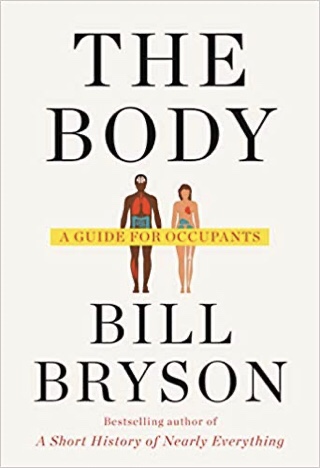
I got this new nonfiction as an e-book from the library, on the recommendation of a friend, fully expecting that with my background, I could find numerous errors and bits of misinformation. Bill Bryson seems to have no specific training in medical sciences and his previous writing has been on diverse non-medical subjects such as travel, linguistics, and general sciences. But he does not rely entirely on his own vast knowledge, but travels the world, hunting down experts on several continents, quoting them and research studies extensively.
I did find a few mistakes, but had to look hard and critically and probably missed some as well. However his own knowledge is wide-ranging, and his awe of the way our bodies are constructed and function is infectious. His generalities, some of which may seem trite to some readers, serve well as a great introduction to human anatomy and physiology, and his documentation of the extent of our ignorance of our own bodies is humbling.
There are more tidbits of information that I never learned in my medical career than I could relate from that long career. He delivers these with wry humour and fabulous analogies and metaphors. Red blood cells are described as shipping containers. “Hormones are the bicycle couriers of the body, delivering chemical messages around the teeming metropolis that is you.”“Antibiotics are about as nuanced as a hand grenade. They wipe out good bacteria as well as the bad.” “Hemoglobin….vastly prefers carbon monoxide to oxygen. If it is present, hemoglobin will pack it in like passengers on a rush hour train, and leave the oxygen on the platform.” Phantom limb pain is compared to a burglar alarm that can’t be turned off.
Written before the Covid-19 pandemic, his insight into the risks of overuse of antibiotics and of a viral pandemic are sobering. He cites results of simulation studies of a drippy nose that will make everyone despair of ever controlling rogue respiratory viruses with physical distancing policies, however strictly enforced.
Bryson also delves into the fascinating but murky world of medical discoveries, replete with wrongly accredited researchers and the serendipitous nature of many breakthroughs. His depiction of the quirky and often prickly personalities of famous biologists is enlightening.
The seemingly pessimistic conclusions about the progress of modern research in the prevention and treatment of many diseases is in accord with the documentation of others including H. Gilbert Welsh in Less Medicine, More Health.There is a huge trove of sobering statistical data that seemingly backs up the pessimistic outlook for our individual and collective future, even if much of it conflates correlation with causation.
Now for some errors or misinterpretations. Your spleen is not on the left side of your chest, nor does food normally enter the stomach through the pylorus. It is not at the moment of birth that “blood from the freshly beating heart is sent on its first circuit around the body.” Is smallpox really “the most devastating disease in the history of humankind?”. Certainly more people over many millennia have died of malaria. The largely uncritical acceptance of the vary biased now discredited views of Ancel Keys in the chapter on nutrition is not in line with the scientific facts documented by Dr. Robert Lustig and Tina Neicholz among others. Not all organ donations except kidneys are from deceased donors.
This is a fascinating, thoroughly enjoyable very educational read. Highly recommended.
Thanks, Maurice.

 The Passionate Reader