The Beggar’s Opera. Peggy Blair. 2012. 340 pages
With more twists and turns than a world class slalom ski course, this murder mystery is the first of four, all set in Cuba or Ottawa in the late 2000s and all featuring the incorruptible Inspector Ricardo Ramirez of the Major Crimes Unit of the Havana police department. The author is a native of Ottawa; the Ottawa Police Department is involved in the intricate plot. There are few innocents, abundant criminals with hidden past secrets, sycophantic political operatives, corrupt cops, social misfits and impoverished simple families trying to survive in an isolated and poor Communist country. There is lots of tragedy and more than enough sexual titillation to satisfy most readers, even if the perversions are seemingly endless and disgusting. There is the overworked stereotype kind and considerate well-meaning prostitute, social misfits and even a victim of the Stockholm Syndrome in a hostage-taking standoff.
The hallucinatory dead man that haunts Inspector Ramirez in all of his investigations remains a bit of an enigma, even at the end, but is tied into both his fears of a having a fatally progressive neurological disease and the pervasive amalgam of ancient Santeria religious beliefs and Catholicism. The inclusion of both achondroplastic dwarfism and Lewy Body dementia in different characters provides realism.
The depiction of the poverty, limited freedom, and pervasive corruption of many Cubans of that era is vivid and realistic. We visited Havana in 2010 and can attest to the contrast of the decrepit housing and poverty next door to the grandeur and opulence of Revolution Square and the luxury hotels reserved for tourists. The fearful cautious reverence the people held to the 1959 revolutionary leader was palpable as an undercurrent. Most of the natives would never risk being heard to criticize their leader in any way.
There are a few quite improbable details. For example I have attended many autopsies, but I have never ever known a pathologist at one to examine the eardrums of a subject in any detail.
Other than the real origin and identity of the hallucinatory dead man that keeps showing up in Ramirez’s visual field, there are no loose ends and an amazing number of unpredictable revelations of unsuspected uniting features are contained in the last few of the seventy eight short chapters.
As murder mysteries go, not at all my favourite genre, this is as good as it gets.
The Poisoned Pawn Peggy Blair. 2013. 316 pages.
The second of Peggy Blair’s murder mystery series, this one follows up on the complicated plot of The Beggar’s Opera with even more complications and clues that seem to be obvious only to the indomitable Inspector Ramirez of the Havana Major Crimes Unit. But in this volume, he spends much of his time in cold wintry Ottawa, interacting with Ottawa police and the R.C.M.P., investigating the international pedophile ring uncovered in the first novel. In my opinion, the writing here is better and although the subject matter is grim, the graphic description of sexual abuses is absent. The plot gets even murkier before finally getting a bit clearer. There are still loose ends and the dead phantoms continue to haunt Ramirez. I presume these lead into Blair’s third novel in this series.
The description of the intricate religious black magic rituals of the mixed race Cubans in Blind Alley, Havana are detailed and interesting, either the result of careful research or of a vivid imagination. The differences between the political and legal environments of Canada and Cuba are carefully contrasted. The characterization of the Catholic Church as essentially a worldwide pedophile ring masquerading as a religion is perhaps a bit of an exaggeration, but by how much? The aboriginal Canadian detective’s description of life in Canadian residential schools is a sobering reminder of our shameful past but also comes across as a preachy politically correct sermon from the author. Tight time lines and deadlines, supposedly with horrendous international consequences, seem transparently contrived to develop suspense, like the annoying countdown on the television baking show Chopped!. The huge life insurance policy taken out just before someone dies in suspicious circumstances is a stale overworked tool of murder mystery novelists everywhere, but they do need to include some motive.
There are some rather obvious inconsistencies The pathologist who did the autopsy never mentioned missing organs, but later claimed the poisoned woman was an organ donor, even though she died far from the hospital. A 76 year old dies of a heart attack on a plane in international air space, yet became a multi-organ donor. These details reveal a lack of understanding of the criteria for organ donation, but perhaps I am more attuned to this than most readers. A man with a syringe full of air, threatening to murder a young hostage, claims “An air bubble in the main artery will stop your heart in seconds.” Really? Don’t arteries lead away from the heart?
Only one good quote from among many: “People desperate to believe in something will believe anything.”
With nothing better to do during my physical, not social, isolation, I was sufficiently entertained by this yarn to move on to Blair’s remaining novels in this series.
Hungry Ghosts. Peggy Blair 2015, 363 pages.
This is the third novel in the murder mystery series, all featuring Inspector Ramierez. The action in this one alternates between Cuba and Ontario, much of the later being on remote northern native reserves. Once again there are many misleading clues, hosts of suspects for many murders and corrupt cops and power-brokers who are quite keen to not just bend the rules but to shatter them completely. And once again there are the mysterious visions of the dead that plague the inspector and seem to guide his investigations.
I greatly admire anyone who can create vivid pictures of the folklore and mysticism of Russian peasants, the extinct Beothuks of Newfoundland, Ontario aboriginals, and the Cuban Yoruba. Blair’s wide ranging knowledge and research for this book also extends to forensic medicine and the way autopsies are carried out, although some of the claims about clues from the later seem to border on magic, such as the divination from blowfly maturation cycles. The William Maples and Michael Browning book Dead Men DoTell Tales is a more realistic treatise on this grim subject.
The much needed humour is sometimes just recycled witticisms and lame puns, but there are also hilarious metaphors: “ Sometimes I feel like I’m one broken-down truck and a dead dog away from being a country-and-western song.”
In any novel with this range of subjects, there will be some mistakes, some understandable, some not. For example she refers to “acid phosphate that should be acid .phosphatase. But the proof reader should have picked up that a pathologist cannot remove an intact brain using only a scalpel, And there are at least two declarative sentences that end with a question mark.
The dozens of red herrings and the still unanswered clues are sufficient grounds for delving into the fourth book of this series- once my wife has finished with it. I have nothing better to do during my hibernation.
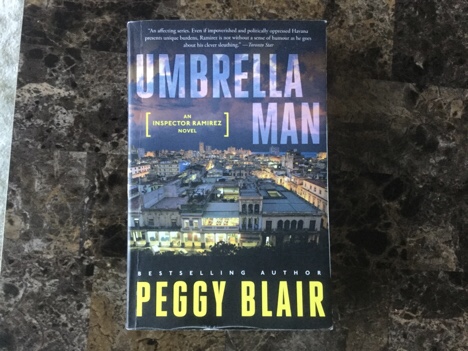
Umbrella Man. Peggy Blair. 2016. 317 pages.
The fourth of the series featuring Ricky Ramirez, the intrepid inspector of the Havana police Major Crimes division was a disappointment for me. I am not sure if this is because Blair’s style has become formulaic or because I rarely like murder mysteries to begin with and also rarely read books that are serialized and must be read in sequence.
In this story Russian and American spies and double agents working in Cuba play prominent roles, but Columbia’s FARC narcos, Chechen mafia and high level corrupt Cuban officials are also featured. There is considerable newsworthy realism such as the poisoning of a Russian defector in Britain using polonium and Russian undercover agents monitoring the dissident Khodorkovsky while he is in prison on orders from Putin. However, there are four interrelated mysterious murders and far too many suspects and subplots for me to keep track of. A constant in all of Blair’s murder mysteries is sexual violence and this one is no exception. It would seem from this account that every single young Cuban woman earns a living as a prostitution and that sex tourism is Cuba’s main industry. Blair seems to never miss a chance to feature the poverty and deprivation of almost all Cubans along with the need for bribery to succeed.
The ghosts of murder victims who plague Ricky in the previous books don’t show up to help him here until……
There are again some inconsistencies. The fingerprints from one of the victims are discussed and analyzed on the day of his murder although they were apparently taken the next day at his autopsy. The findings in another victim’s apartment are discussed after the detectives decide that they did not have authority to search it.
Readers who enjoy murder mysteries will like this series, as did I until the characters and plots got tiresome.



 The Passionate Reader