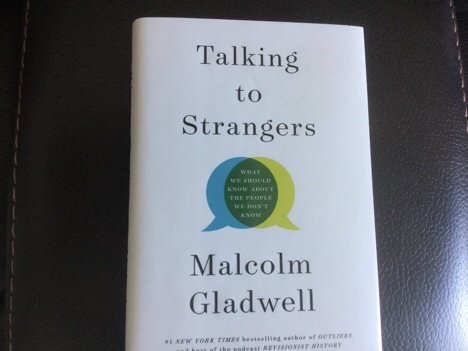
The author of the insightful The Tipping Point, Blink, and What The Dog Saw is back with more of his unique commentaries about modern society, human nature, and contemporary American life. His insights as a keen observer and his wide-ranging analysis are on full display as he explores how individuals and groups interact with complete strangers, ranging from police officers at roadside stops to CIA agents interrogating jihadist terrorists.
We all meet strangers frequently and must assess their character and intentions quickly and accurately. Yet evolution has not equipped us to to do this with any degree of precision. We generally “default to truth “ which could be more accurately described as default to belief as we are inclined to believe what strangers tell us, verbally or by ‘body language’ until proven wrong. But there are those among us who refuse to defer to belief and sometimes become heroes as whistleblowers but more often are paranoid conspiracy theorists. Even more often the nonverbal communications of strangers are misinterpreted sometimes with tragic consequences. Our ability to “read” others must be on a spectrum but even experienced cops and judges often get it all wrong. One counterintuitive thought of my own: perhaps one minor reason that the divorce rate for arranged marriages is one tenth of that for others is because of the deceptive behaviour and communications intrinsic to courtship.
Gladwell shows us that our culturally-rooted interpretations of facial expressions of emotions are prone to systematic errors, which must be exacerbated when we are limited by quarantine, something he could not have foreseen when this book was written. There must be a spectrum of responses to our encounters with strangers from those who too naively expect honesty from everyone to the paranoid or suspicious who see every such encounter as probably loaded with sinister hidden meaning.
Gladwell makes much of the fact that our interpretation of the motivation and messages from strangers is based on stereotypes from such shows as Friends, and favoured expressions in novels (raised eyebrows, dropped jaws), and shows that the interpretation of physical and physiological clues can go dangerously wrong when those clues do no conform to what we expect. Judges do worse than computers in deciding whether or not it is safe to release suspects on bail, in spite of having access to eye to eye contact. When there is a mismatch between facial expressions and behaviours, interpretations can lead to erroneous conclusions with disastrous results. “…with strangers, we’re intolerant of emotional responses that fall outside expectations.”
There are are several criticisms I could level at this book. In spite of Gladwell’s unique insights, I found the book to be disorganized with his really original observations of human nature sprinkled haphazardly throughout it. Sometimes the logic of his reasoning seems a bit convoluted and strained in getting to the counterintuitive conclusions he is so fond of. His discussion of alcohol as the common denominator in campus sexual assaults simplifies the neurological effects of alcohol to the point of a distinction without a difference.
There are many unique and surprising undisputed facts revealed in this smattering of brain droppings. Suicide and crime rates are coupled to specific places and specific methods, not to particular circumstances, contrary to what common folklore would have us believe. For example, we are told and most people believe that someone intending to commit suicide would do so by a different means if their first plan was foiled, but the evidence is that this rarely happens. TSA baggage checkers at airports fail to detect a gun planted in luggage 95% of the time; most could work for 50 years and never find a hidden weapon.
I found this book to be filled with interesting, and original observations, but also not as loaded with insights as his previous revelations. Nevertheless a good read.
Thanks, Andra.

 The Passionate Reader