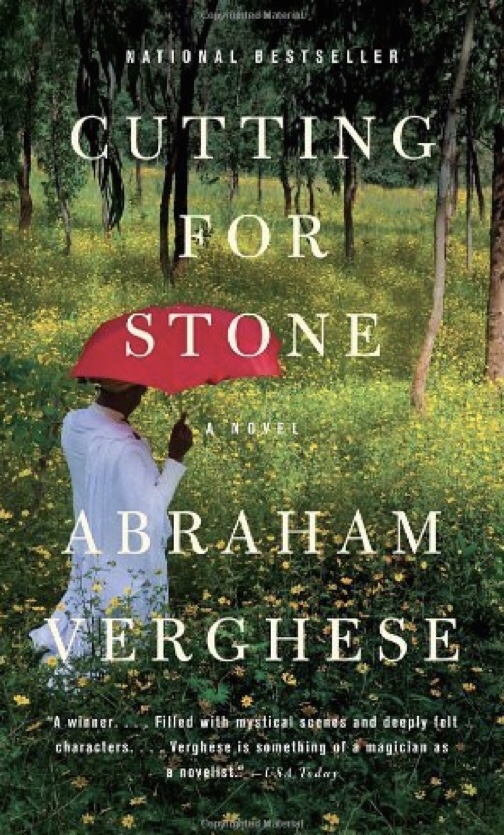
Richly endowed with plot twists and emotional rollercoasters, this grand medical epic has something for everyone, whether from a medical background or not. There are hundreds of medical observations, aphorisms and adages, some original and many from earlier works, including the obscure title (from Hippocrates). But none are difficult for the reader to understand and appreciate.
At an ill-equipped hospital in Addis Ababa in 1954, identical conjoined twin boys are born to a nun who promptly dies and a surgeon who promptly disappears, only to show up many years later, in New York. The characters include guerrilla fighters, surgeons, gynaecologists, and many patients, relatives and servants. There are hundreds of names, procedures, diseases and experiences that reminded me of my years of medical training in the 60s and 70s. Even when relating illnesses such as fulminant hepatitis B, which I dealt with frequently, I did not find any faulty information or impossibilities. I can readily relate to the graphically described utter exhaustion of on-call interns and residents. (One morning after almost no sleep for days, I asked a head nurse where old Joe was, to be told that I had declared him dead at 2 a.m. that very morning, a visit I had no memory of).
The emotional lives of doctors and their sometimes difficult decisions in an emergency are easy to relate to, but there is no adulation for any individual, even including the narrator, the older twin who gradually assumes the first person singular tense as he reaches the age when accurate memories are possible. The inequities of medical care in the U.S. are exposed without comment or judgement, as might be expected since the author was born in India, raised in Ethiopia, and is now a Stanford professor of medicine.
Among dozens of memorable quotes, here are two of my favourites. “A rich man’s faults are covered with money, but a surgeon’s faults are covered with earth.”
“Now that I was a patient, my curse was that I knew too much.” – a curse that every doctor with a serious illness has experienced.
There are no loose ends, but there are some possibly intentional inaccuracies. For example, the development of successful liver transplantation is depicted as occurring several years qearlier than in reality, and at the time that Dr. Thomas Stone was said to be performing many liver transplants in Boston, there were only four centres in the world doing them successfully -Pittsburg, Pennsylvania, Cambridge, England, Hamburg, Germany, and London, Ontario. But Verghese’s unforgivable assertion in the Acknowledgements that “every liver transplant surgeon in the world was trained by Starzl or by someone who was trained by him” ignores the contemporaneous, brilliant, trailblazing work of Sir Roy Calne in Cambridge and my colleague and classmate Bill Wall in London, Ontario. Perhaps he has, in spite of his background, forgotten that there is a world outside the U.S.A.
I have not read the author’s previous two memoir books, nor have I seen the movie adaptation of this one. But they can’t be better than this gem.
Thanks, Vera.

 The Passionate Reader