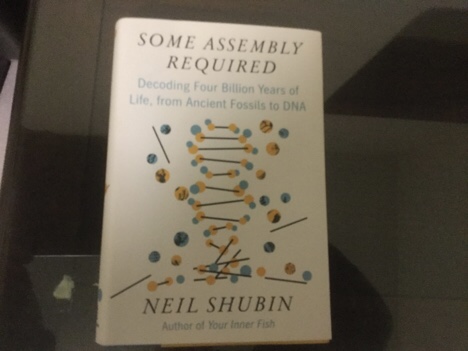
I enjoy seeing and reading about the astonishing complexity, adaptability, beauty (and cruelty) of most life forms, so when I read a rave review of this new science book somewhere, I knew I had to have it, although it was $34 at Indigo. The author is a brilliant knowledgeable Chicago anthropologist with a wide range of experiences.
Starting with the criticisms of the 1869 edition of The Origin of the Species, (addressed in the 1872 edition), this is a combination genetics treatise, introduction to anthropology, embryology, and cell biology and an eclectic discussion of the origins of life.
Much of the material was not new to me as a medical scientist, although I last studied embryology in 1967. I do not dispute the enormous contributions that the humble fruit fly, Drosophila melanogaster, has made to the field of genetics, but reading about it brought back bad memories of cramming for exams. And Haeckel’s faulty assertion that “ontology recapitulates phylogeny”i.e. that we go through the stages of our evolution as we grow from paired gametes to newborns was still hotly debated in 1967.
There is also abundant new information including the role of regulator genes and jumping genes in organ differentiation, the incorporation of repurposed viral genomes into our DNA and the details of how environmental factors influence gene expression. The author assiduously avoids any discussion of the philosophical arguments surrounding free will and whether or not we are more than the predetermined expression of our genes, and the added influences of environments on them.
Shubin convinced me that hubristic computer scientists who think we are in danger of being outdone by their artificial intelligence machines and complex algorithms must be clueless about the infinitely complex functioning of the human brain. The successful mapping the human genome, accompanied by overblown hype, was just a start in understanding the basics of modern genetics.
The writing is straightforward dry narrative with little dialogue and not much humour. I found some parts such as the discussion of jumping genes difficult to understand, while other parts were a rehash of facts that will be common knowledge to most educated readers. But I have to admire the dedication to increasing our knowledge of anyone who can spend years doing nothing but studying the variability in one thousand salamander feet. (I once watched an equally dedicated optometrist carefully dissecting the eyes of every salmon and trout he caught at our fishing camp).
I learned a lot from this book but it is not for everyone; I am not sure who to recommend it to. It seems to me that Shubin neglected to ask himself the critical question every author should ask before writing a word: who is my target readership?

 The Passionate Reader