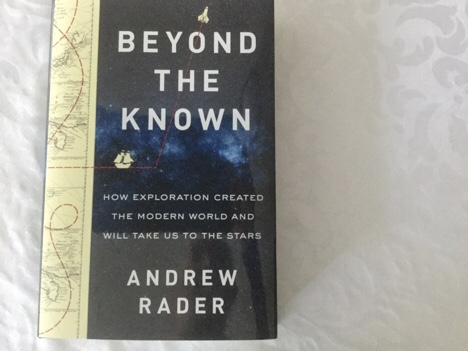
This chronological account of explorers, adventurers, empires, and sciences is a very broad and incredibly detailed history of civilization from our origins in the Rift Valley to the space age. Rader has sensitive antennae for the quirky, little known details that make history seem relevant, not at all like the dry memorization of dates and facts I had to learn in high school. In some ways it is similar to Yuval Noel Harari’s Sapiens and Jacob Bronowskl’s The Ascent Of Man but with more details about daredevil explorers and scientists breakthroughs. The book is packed with colourful characters and details of many cultures.
There are hundreds of minute surprising details about people, places and events that were completely new to me, not the least of which is the obscure derivations of many words and place names in the English language. For example the Lacine Rapids at Montreal were so named because Jacques Cartier thought they were the only obstacle to his reaching China when sailing up the St. Lawrence River.
Only one great quote among many: “ If earth’s history were a day, life appeared at 4:00 a.m,, fish at 10:24 p.m., dinosaurs at 11:45 p.m., and humans at 11:59 p.m. All recorded history took place within the last quarter second, and Columbus sailed at 1/100th of a second to midnight.”
It is not hard to predict the buildup to the last few chapter’s boosterism for space exploration and eventual colonization of other planets as Rader leads the reader to compare today’s space explorers to past adventurers and leaders. After all, he is a manager at SpaceX, Elon Musk’s private enterprise to promote space exploration. But I am amazed that a rocket scientist also knows and relates more interesting historical details than most academic historians. And he seems to uncritically equate continuous technical progress with moral progress, a common but not easy position to defend. His other questionable assumption is that human life on earth is doomed in the near future, rather than millions of years from now when our descendants will be fried by the sun. His infectious enthusiasm for space exploration and colonization with the details of possibilities almost, but not quite, convinced me that my grandchildren or great grandchildren might some day decamp to Mars. But it seems likely that some black swans will arise and dampen the enthusiasm, as they have for almost all explorers.
The writing style is prosaic with mostly short two-line definitive sentences, like the clipped stucco speech of the author on his podcasts. The few attempts at humour generally fall flat. One real criticism is that in a long chapter about the rise and fall of China as a world power, there is no mention of the Great Wall. Perhaps it is just too insignificant in such an epic account of mankind.
This book is not for everyone but there are so many interesting little facts that it kept me engaged.
Thanks, Ian.

 The Passionate Reader