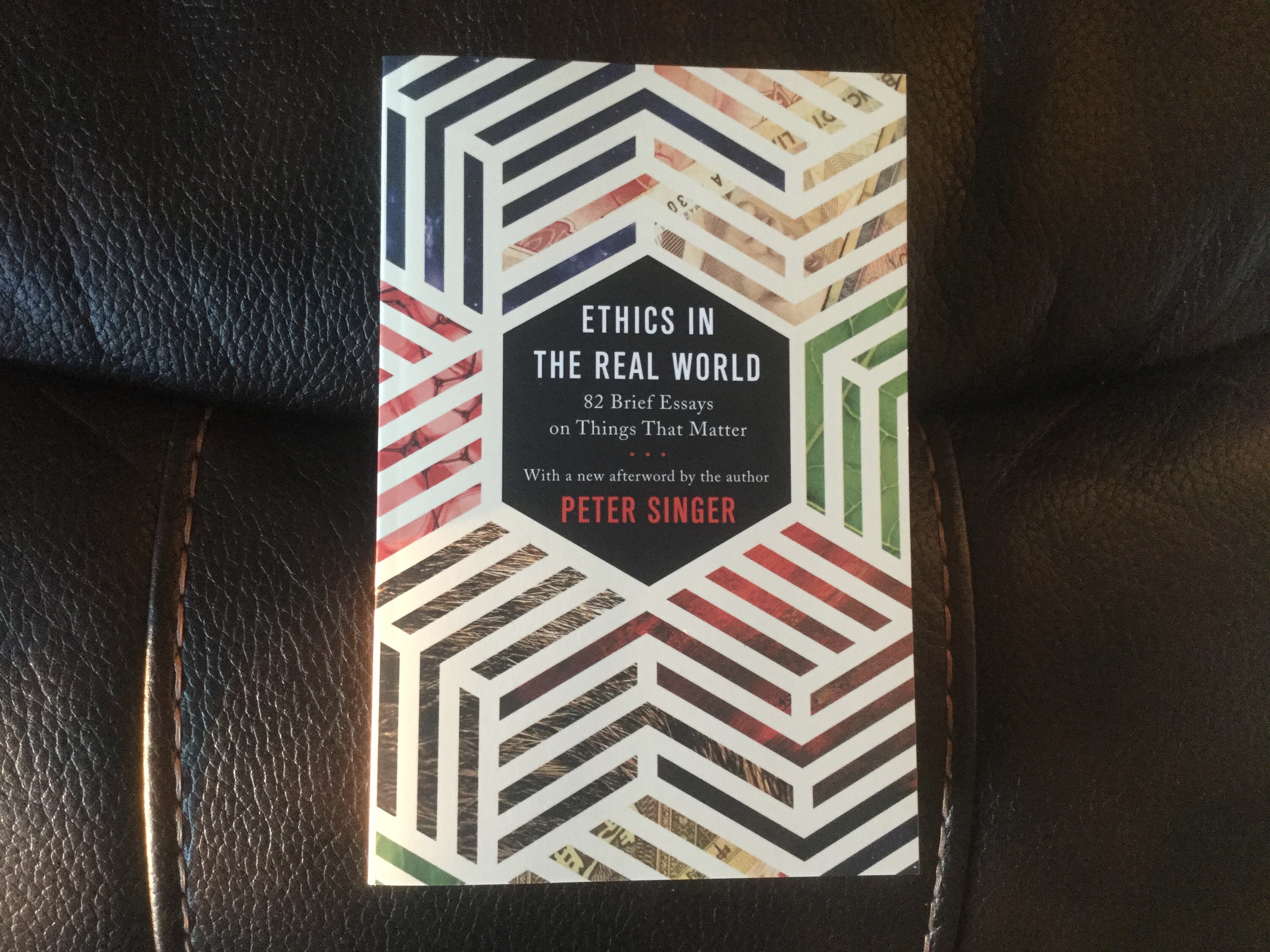
One of the world’s best known modern philosophers, the Australian-born Princeton professor here collects “82 brief essays on things that matter”, mostly written for news outlets and scholarly journals between 2001 and 2015. The selection of topics is very wide-ranging and, and unlike most output from philosophers, is easy to understand for anyone with a grade 10 education and an ability to reason. Singer is that rare philosopher who makes the subject interesting, understandable and relevant to everyday life. Presumably the selection is from those that he could get permission to reprint.
His enlightened views about raising animals for food, charity, and the risk of ignoring science generally and that of climate change in particular, are well known to his followers and clearly reiterated in these essays. Some other brilliant suggestions to improve ones personal ethical behaviour were new to me and very controversial. His stance on abortion and euthanasia are predictable and carefully reasoned out. His arguments on limitations to free speech, and about doping in professional sports are innovative and controversial. Some suggestions seem only marginally connected to ethics (at least to personal ethics), such as recommending that airlines charge travellers based on the combined weight of their bodies and their luggage since that relates best to their actual cost for moving that person.
His passion for ethical treatment of all animals shows up again and again, and is almost enough to make me swear off meat, not only for the sake of the animals, but also as a contribution to the effort to combat climate change. But when he condemns all forms of fishing because of the distress it causes the fish, I become uneasy. I like to think that the enjoyment that I get out of being able to deceive a trout or bass with a fly of my own design counts for more than the minor discomfort of a small puncture in the mouth of a fish. And as I invariably practice catch and release, I am free to imagine the pleasure and relief a fish may experience as it swims back to safety. He fails to address the cruelty of animal deaths in the natural course of events as an alternative to us killingly them quickly and painlessly. And leaving an animal to die after being mauled and maimed by a predator is not being kind; nature can be as cruel as keeping a disabled human being who wants to die alive by artificial means. The difference is that we can’t determine the wishes of an inarticulate animal with no concept of the finality of death (as far as we can tell).
A great collection of essays from my favourite philosopher, this book can be read selectively for topics that interest you. Most essays are only two to three pages in length.
Thanks, Andra.

 The Passionate Reader