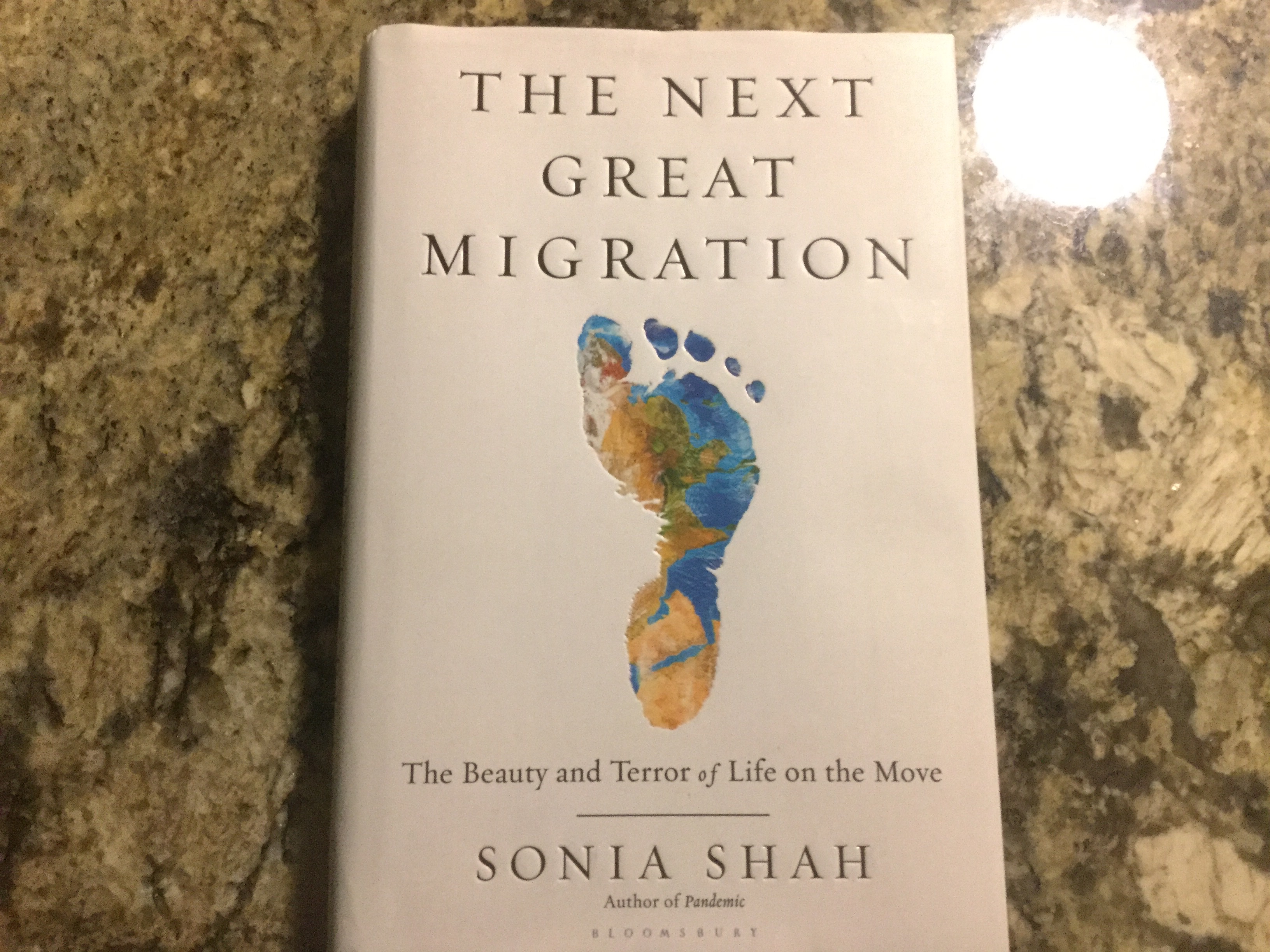
There is, within this passionate plea for better understanding of all manner of living creatures constantly on the move, a plethora of keen insights and sobering thoughts. Shah points out and documents that mass migrations are not a recent phenomenon, but have always been an integral part of the adaptation of all living things to a constantly changing environment. The extent to which humans have moved about in the past was not well known until recently. The personal stories of people risking their lives to cross the Mediterranean Sea or the Mexico-Texas border are heart wrenching. We easily forget that national borders with rigid restrictions on crossing them are a relatively recent feature of human history and have never existed for other forms of life, whether flora or fauna. The message that integration of migrants into western cultures generally benefits everyone including the longtime residents of the host nations, needs to be emphasized, especially in this time of xenophobic nationalism.
A chapter on the baseless, overtly racist politics, with scientists being complicit in the eugenics policies then applied, of the early 20th century is timely given the current U.S. and European treatment of migrants. A superb discussion of the artificial distinctions between native and (exotic) invasive species shows the futility of turning back the clock to allow for only the growth of so-called native species. The estimates are that 99 % of ‘invasive species’ actually increase the biodiversity in their new environments. It could be argued that we are one of the few truly dangerous invaders and perhaps the worst of all invasive species, destroying vast swaths of biodiversity to grow monoculture crops, driving many other species to extinction, and doing irreparable damage to the climate.
Along the way, Shah heaps scorn on Linnaeus, Malthus and a host of other revered scientists for their artificial distinctions and wild predictions based on armchair science with no field experience. The story of lemmings undergoing mass suicide, now a stand-in for blindly following the leader, was created by such scientists and popularized by the special effects team of Disney Films. It is a complete fabrication.
I found the writing to be a jumble of interesting facts thrown together haphazardly, with constant switching back and forth from discussion of the history of migration of plants and animals to that of humans at different times. And like many reports in social sciences, there are dozens of studies where correlation is uncritically equated with causation. That misinterpretation of data led to such atrocities as widespread forced sterilization of the poor as being ‘feeble-minded’ and unfit to reproduce. They were feeble-minded because they were poor and were denied access to good education- a vicious cruel circular argument. There are also a few biologic impossibilities asserted (e.g. living at high altitudes does not make the blood thinner) and some minor spelling and grammar errors. The complex maps meant to clarify points in the text just confused me.
I have mixed feelings about recommending this book, but learned a lot from it.
Thanks, Andra.

 The Passionate Reader