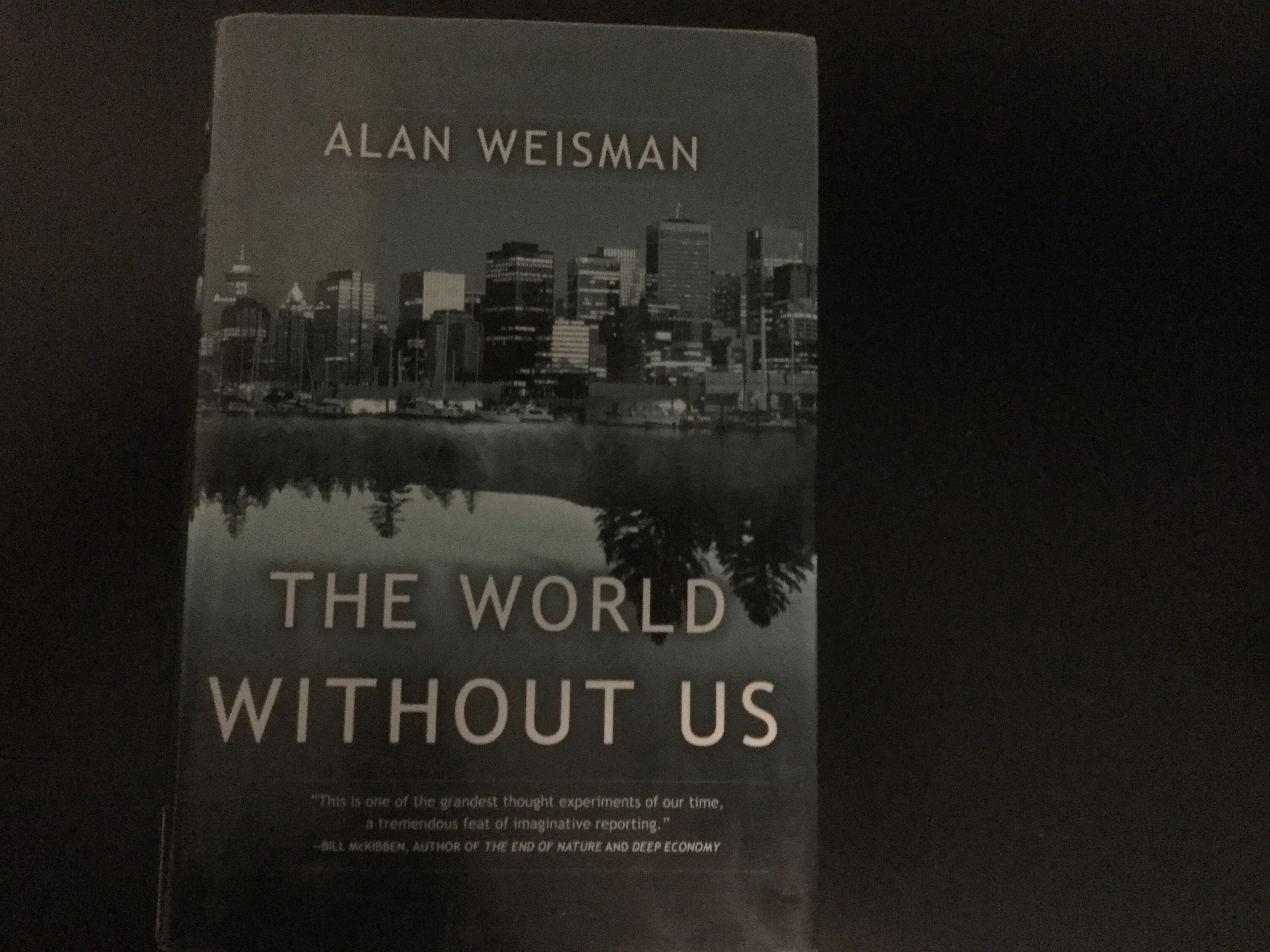
The thesis in this thought-provoking book is neatly summed up on page 4 of the Prelude. “….picture a world from which we all suddenly vanished.” Then, ominously, “Say a Homo sapiens specific virus…picks us off but leaves everything else intact.” But it also goes into great detail about what the world was like before we arrived on the scene, and how our existence has altered that.
The author is a science writer whose Harper’s article about life around Chernobyl after the meltdown got me interested in this tome. Packed with obscure, often counterintuitive observations, it is nevertheless highly speculative and full of depressing facts about the harm we have done to our home planet and other life forms that we share space with. This includes the Africa-sized three million tons of plastic in the Great Pacific Garbage Dump, the long-lasting effects of petrochemical pollution, climate change, and reduction of biodiversity everywhere.
If we were to suddenly disappear, explosion of petrochemical storage facilities would dump massive amounts of toxic waste into the atmosphere and the oceans, and radioactive waste from unmaintained reactors and storage sites would harm every other species, but mosquitoes and fish might become more plentiful. Our newest buildings would collapse before some ancient structures. Birds would stop killing themselves by the millions in collisions with glass windows and buildings.
The topics discussed include a broad range from archeology to all kinds of biology, ecology, astronomy, physics and chemistry. The writing is largely humourless and dry, and I found some ‘what if’s’ so unlikely as to be hardly worth our speculation. That includes the discussion of a virus that is so specific as to wipe us out without touching any other species. Such a virus cannot logically develop as it would self-annihilate, contrary to everything we understand about evolutionary science. In discussions about crumbling concrete under the influence of freeze-thaw cycles, there is no recognition that there are differing grades of concrete, some designed to specifically counter such effects. And concrete is at times equated with cement. I cannot pretend to understand the engineering jargon used to describe the crumbling of the Panama Canal after we depart nor much of the astrophysics.
The author makes a powerful argument to limit the birth rate of Homo sapiens to one child per fertile female to reduce our population to at least nineteenth century levels to reduce the harm to our home planet, but does not discuss the sociological effects of that, as seen in China. And I am bored with speculations about somehow removing ourselves to some other planet after we have destroyed this one, as I will not be around if/when that becomes a possibility.
A depressing read that nevertheless delivers important information for planners and public officials to consider, this book should be consulted before undertaking major projects affecting large populations. But it is of limited use for everyone else, though stuffed with interesting facts that could be used enliven a faltering cocktail party conversation with almost anyone.

 The Passionate Reader