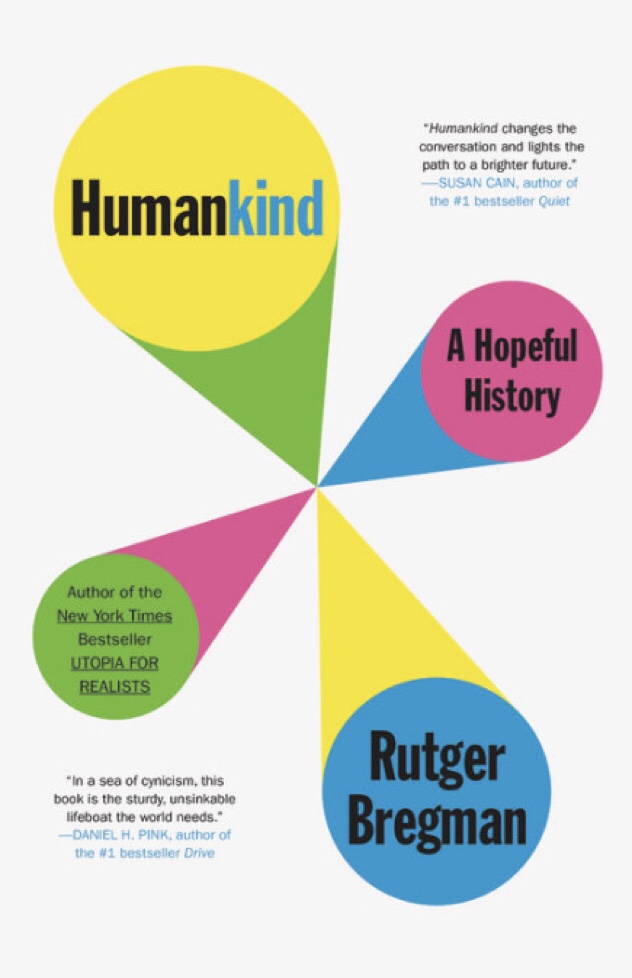
I enjoyed reading Philip Zimardo’s The Lucifer Effect, Yuval Noah Harai’s Sapiens, Malcolm Gladwell’s The Tipping Point, Hannah Arendt’s The Banality of Evil, Richard Dawkin’s The Selfish Gene, and Jared Diamond’s Guns, Germs and Steel. But none of these scholarly academic works escapes unscathed from the exposure and critical dissection in this Dutchman’s reassessment of the basics of human nature. His iconoclastic takedowns extend also to Thomas Hobbes, David Hume, Adam Smith, Milton Friedman, William Golding (Lord of The Flies), most modern gurus in business, journalism, entertainment, economics, education and politics, and even Winston Churchill to a limited extent. Who does he not denigrate? His hero, Bertrand Russell.
Yet it is hard to defend any of these given the extensively researched (over 800 source references) arguments presented. The basic dichotomy discussed is between Thomas Hobbes’s Leviathan’s view of humans as intrinsically selfish and evil, leading ‘solitary, poor, nasty, and short’ lives and Jean Jacques Rousseau’s social contracting, kind, altruistic man. Which is the more natural one? The former has the backing of many religions promulgating the doctrine of original sin, and is seemingly taken for granted in most of the works cited above. The issue is of great practical importance since our behaviour as social animals is predicated on our expectations of the outcome of encounters with others. If we expect others to act cruelly and selfishly, our actions will probably be self-fulfilling and make them do so. This he dubs the nocebo effect, the opposite of the placebo effect. This word should become an official dictionary-defined English word.
Bregman compares the news to a drug that is “super-addictive, causes,… ‘a misperception of risk, anxiety, lower mood levels, learned helplessness, contempt and hostility towards others, [and] desensitization.”
Philip Zimbardo’s Stanford prison experiment comes in for particular scorn, being described as a hoax and a ‘staged fake.’ Likewise, Malcolm Gladwell’s supposed documentation of the bystander effect, which left out or altered important details which would have completely destroyed his assertions about passive unhelpful bystanders. To be fair to him, his media sources also slanted the story to fit with the more sensational narrative of the intrinsically uncaring nature of humankind; that sells far better than any story about the kindness of strangers. Bregman strongly encourages us to meet and greet people from very different backgrounds, people my staff secretly dubbed ‘NOSP-not our sort of people’, to increase mutual understanding and develop compassion, which he distinguishes from empathy. Maybe some nuance was lost in translation here.
Bregman is no starry-eyed socialist dreamer. Focusing in on results of experiments on prison reforms in Norway, school reforms in Holland, police reform in NewYork City, citizen budgets in Venezuela, business management reform in France, and government fiscal reform in Alaska, all based on the principle that everyone should be thought of as kind and considerate until proven otherwise, he documents surprising improvement in a variety of outcome measures.
There is just a sprinkling of clever humour-“All too often, the sharing economy turns out to be more like a shearing economy–we all get fleeced.”
But there are so many counterintuitive insights in this book that I can’t think of anyone who would not enjoy and benefit from at least parts of it. It is a very upbeat but realistic educational gem. I will be buying this one as Christmas gifts. It is the most enjoyable nonfiction book I have read in several years, and strikes a very positive note at a time when we all need one.
Thanks, Pat.

 The Passionate Reader