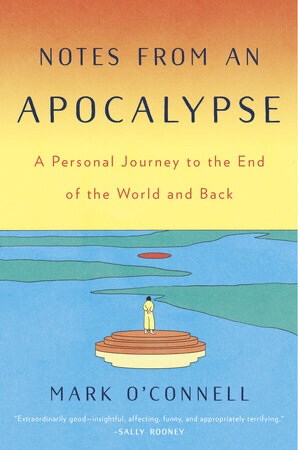
I accidentally deleted my review of this from a few weeks ago, so I am redoing it from memory. This Irish father of two muses about when and how the world of human beings will end as end it certainly will. Whether we disappear suddenly due to a nuclear war, a massive unforeseen natural disaster or more slowly because of something like climate change, is unknown, as is the timeline. This could be considered as a real downer or as a call to action to at least delay the inevitable. He frets about the ethics of bringing future generations into an uncertain world and acknowledges his own guilt in contributing to the demise by flying around the world and using up scarce resources in a wasteful capitalist consumer-oriented society.
He visits and mocks the residents of the huge bunkers in North Dakota occupied by preppers who think only of their own survival, with their paranoid misogynist, anti-Semitic selfish ideology, aligned with libertarian political ideology. Then he visits a California Mars Society convention organized by equally selfish individuals who plan to escape any earthly apocalypse by colonizing the red planet. He notes that the survival from natural disasters in the past has always depended on collective selfless community actions, and that the environment of Mars is and always will be less hospitable to humans than that of Earth, even in the worst case scenarios. He visits the equally selfish huge estate that Peter Thiel of PayPal fame has purchased in New Zealand along with his purchase of New Zealand citizenship. Lastly he visits the devastated Chernobyl Exclusion Zone to see what the world without us would look like forty years on a la Alan Weisman’s “The World Without Us.
The message in this is that we can collectively help to mitigate and delay the apocalypse if we each do our part, and his humorous tender interactions with his small children make it seem imperative that we do so. I, for one, even with a dwindling reservoir of altruism, would prefer to go down with Mothership Earth, than to live with the guilt of knowing that I could have helped some non swimmers to safety, and didn’t. Like Solzhenitsyn’s One Day in the Life of Ivan Denisovitch, this is a surprisingly upbeat message about enjoying the simple things in life, and a call to do what we can to preserve what we have. I really enjoyed it.

 The Passionate Reader