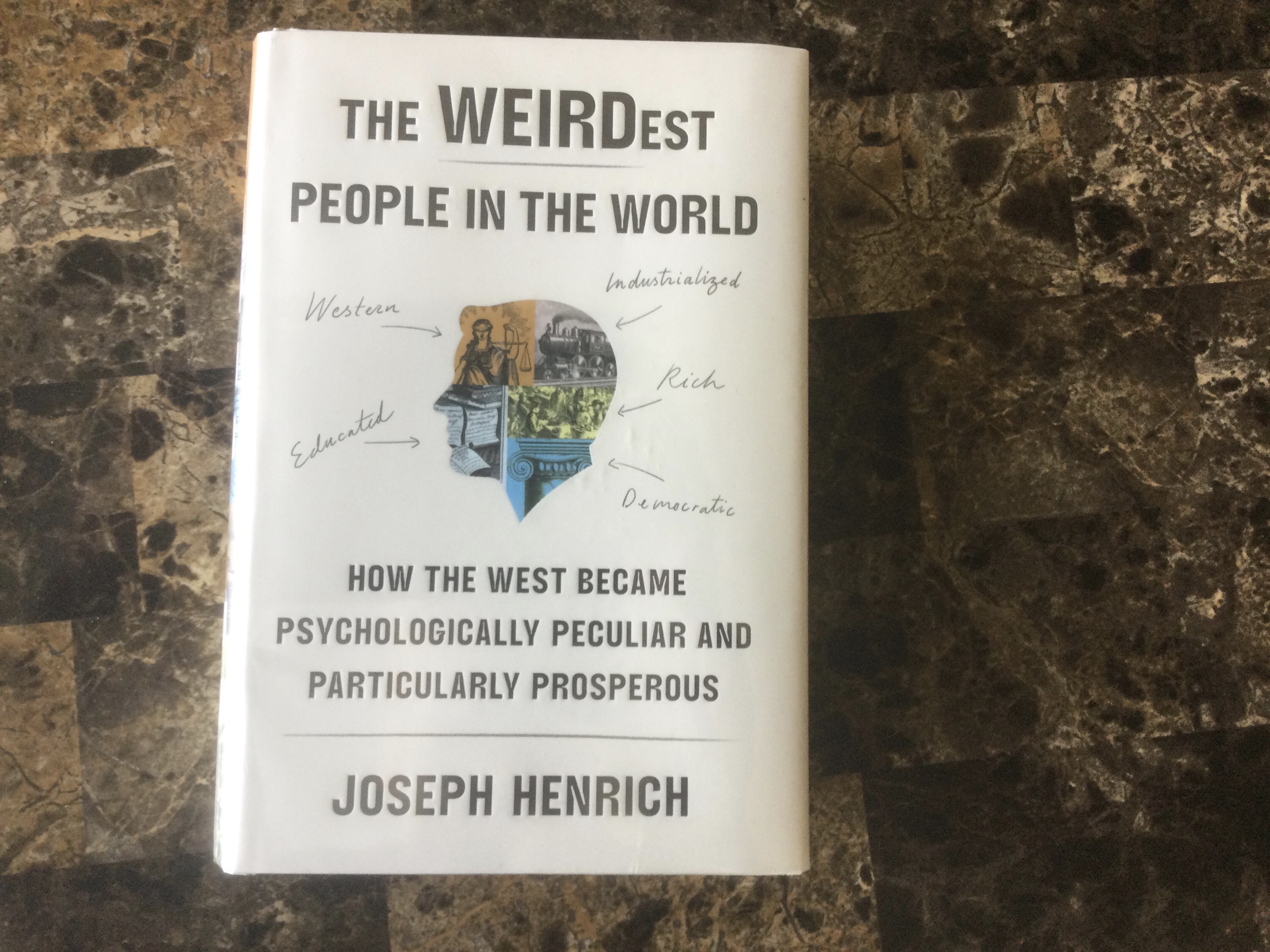
I guess that I am WEIRD (Western, Educated, Industrialized, Rich, and Democratic), as defined by this Harvard social scientist who spans ethnography, psychology, and anthropology. I certainly belong to a WEIRD society, although I am only one generation removed from a partially kin-based patriarchal society in which six or seven closely related nuclear families bonded and worked together in a loose, non-monetary, informal, agricultural society, and never kept score, paying farm helpers only if they were unrelated, more like an early medieval society than a WEIRD one.
The influences of a host of factors including genes, environments, religions, climate, and geography over millennia are explored in an attempt to explain how we became the minority WEIRD society in the world. An encyclopedic range of facts is cited and what seems like a few thousand observations and experiments from all of the social sciences. In many ways, this dense tome extends the work of Jared Diamond in Guns, Germs and Steel, and builds on the theses of Francis Fukuyama in The Origins Of Political Order, as it relates to the development of modern institutions and legal processes.
Chapter 6 on the role of the self-serving edicts of the Church in promoting individualism, universalism and critical thinking by restricting marriage options is very perceptive and well worth reading. And Chapter 13 (of 14) presenting the reasons in cultural evolution for the late explosion of inventiveness has some fascinating insights. But some of the dozens of maps, scattergrams, and histograms, all in impossibly small print, scattered throughout the book and appendices are problematic for anyone schooled in data manipulation and statistical analysis. Although Henrich cautions the reader early on about the non-generalizability of studies of unrepresentative Western university undergrads and the hazards of equating correlation with causation, he uses such studies liberally to come to conclusions based solely on correlations, some of which may not even reach statistical significance. He uses artificial constructs such as the Kinship Identity Index and the Generalized Trust Question to derive those correlations. Mark Twain, among others, popularized the cynical observation that ‘there are three kinds of lies; lies, damn lies, and statistics’. How seriously should we take conclusions based on convoluted experiments on remote jungle tribespeople dreamed up by social scientists ‘over a few pints’ in a Vancouver pub? And I for one am not very interested in distinctions between the meaning of the words clan, chiefdom, tribe, fiefdom, stratified chiefdoms, state, and kingdom, given the problems of different nuances of these words translated into dozens of languages.
Henrich has reviewed a massive amount of data and is undoubtedly brilliant. The 190 pages of appendices, notes, bibliography, and index attest to the amount of work that has gone in to producing this humourless, dry, and wordy treatise. After reading this and Rutgers Bregmans Humankind, I dreamed up a recipe for a feast of optimism about the future of our species: take the overriding message here that human psychology is very malleable, stir in a generous dose of Bregman’s positive vibes about human nature, and add a dash of aged common sense.
I persisted to the end, so now you can talk about it intelligently without reading it, but I did so only by taking frequent breaks to read a chapter of an easier book, and I skipped the middle parts of a few windy long paragraphs. But I admit that I learned a lot in spite of my reservations, and probably have had new circuitry wired in my noggin. E.g. What is the origin of the word anathema? Why is my son’s wife known as my daughter-in law? And being Protestant increases your risk for suicide- not just a correlation.
Given the rave reviews this book has received in The Atlantic, The NewYorker, The Economist, and The New York Times, its spine displayed prominently on a bookshelf behind a T.V. talking head would be viewed as an asset. But it will not be on my bookshelf, even though it is a great reference source for academic social scientists-it is back in the library for someone else to struggle through. But maybe that’s because I am not just WEIRD, which is after all just a clever catchy play on words and only meaningful in one language, but also weird.

 The Passionate Reader