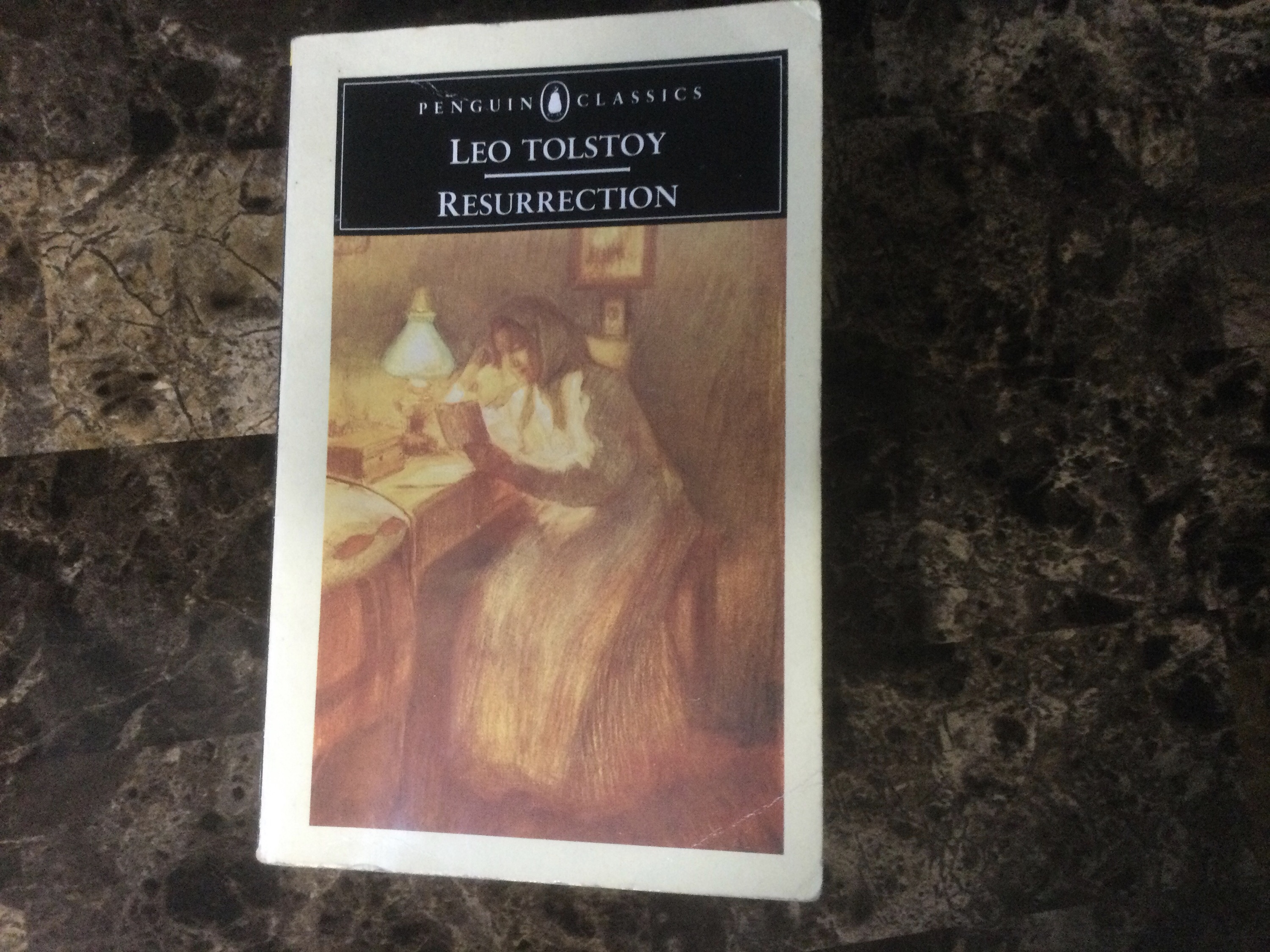
I recently found this old classic on our bookshelf, complete with a faded St. Petersburg postcard, which indicates that I previously read it over thirty years ago. With no recollection of the details, I reread this 1966 Rosemary Edmonds translation.
Prince Dmitri Ivanovich Nekhlyudov, an aristocratic landowner seduces and impregnates the charming Katerina Maslova, a.k.a. Katusha, then abandons her. Later he spends years trying to assuage his guilt as she descends into a life of prostitution and crime. She is sentenced to hard labour in Siberia for a murder she unwittingly contributed to. I won’t give away more of the complex plot except to say that Tolstoy uses the extensive moral self-examination of Nekhlyudov to covey his late-life blistering socialist condemnation of the stratified Tsarist Russian society of the 1880s, the hypocrisy of the Orthodox Church, and the cruel criminal justice system that punishes poverty and maintains the elevated status of the real criminals in the aristocracy. If he had been born slightly later, Tolstoy would probably have been a prominent Marxist Bolshevik.
There are many great timeless observations, highly relevant today. On peer pressure: “At first Nekhlyudov made a fight for his principles but the struggle was too hard, since everything he considered right when he put his faith in his own conscience, was wrong according to other people and vice versa…”.
On human nature: ..”whatever a man’s position may be, he is bound to take that view of human life in general that will make his own activity seem important and good.”
On the organization of (Russian) society: “a society where the suffering borne by millions of people in their efforts to ensure the convenience and comfort of a small minority was so carefully concealed that those who benefitted neither saw nor could see this suffering and the consequent cruelty and wickedness of their own lives.”
Many observation such as the prisoner Simonson’s religious beliefs in panpsychism are ahead of their times and are echoed in later philosophical writings. The dangers of blindly following orders ‘from above’ are exposed long before Nazism. Although all religious dogmas are dissed, Tolstoy seems to accept as a given that some vague deity dictates rules for human behaviour, as demonstrated in the last few pages when Nekhlyudov finally finds peace and joy in rediscovering the message of Jesus in Matthew, chapter xviii, and in the Ten Commandments.
As in all Russian literature, the long unpronounceable names with multiple patronymics can be confusing to western readers, but there are fewer main characters here than in War and Peace.
In some ways this is similar and complementary to Dostoyevsky’s earlier Crime And Punishment, but I found this a more enjoyable read. Most critics rate War and Peace and Anna Karenina as Tolstoy’s best novels, but to me this later one is vintage Tolstoy at his very best.
F

 The Passionate Reader