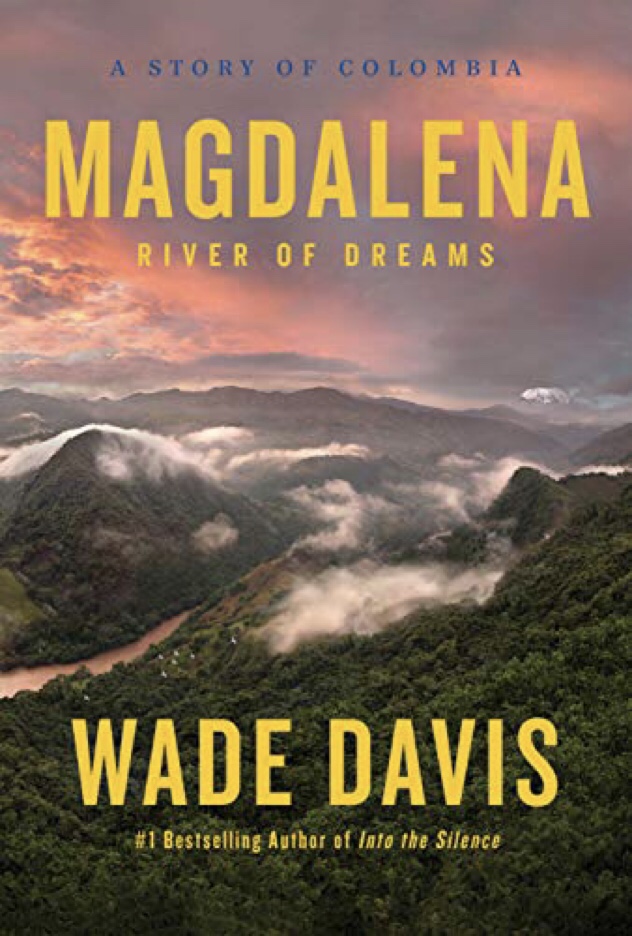
I read a rave review of this documentary of Columbia’s Magdalena River in The Economist and decided it was worth a peek. I rarely start in on a book without reading to the end, but I was sorely tempted to abandon this one. Yet, unwilling to admit to any snobbish sense of cultural superiority, I persisted to the end.
This book provides more than most English bibliophiles would ever want or need to know about the bloody history, culture and geography of Columbia. There are parts that are fascinating and memorable. Early on the British Columbia-based author discusses the drug culture and the role of the U.S. in stoking the market for cocaine, carefully distinguishing the latter from the mild stimulant coca leaf from which it is derived. The account of the mysterious megaliths of St. Agustin, rivalling those of Easter Island, the history of the rise and fall of Simon Bolivar, and the devastation and cruelty wrought by Pablo Escobar’s and other drug cartels are all interesting. The devastation of the 1984 eruption of the Nevado de Ruis volcano burying the town of Amero should not be forgotten.
The river itself is described as a sentient intelligent being desperate to tell it’s story. Davis appears to accept the prevalent beliefs in an afterlife and the myths propagated by the Catholic Church and praises the local profiteers of magic who fish thousand of bodies and body parts from the river and give them the last rites. They then adopt the unknown bodies to speed their souls out of purgatory to heaven. The references to religion throughout document an amalgam of many native and African nature- worshipping systems and a very flexible accommodating Catholicism. Anything to do with the natural world, whether animal, vegetable or mineral is a mystical object of worship. The magic realism of Gabriel Garcia Marquis, who also set some of his stories along the Magdelena, most notably Love In The Age Of Cholera, begins to almost make sense in light of this prevalent belief in magic among his compatriots.
The author freely admits to loving almost everything Colombian. As he travels along the course of it’s famous river, the geography is described in detail, and the history and culture is related in part by the natives he encounters and befriends and in part by the author himself in long scholarly diversions.
The writing flows like the river. On the dramatic rebuilding of Medellin after the peace accord with the FARC warriors: “On a mission to save their city, they embraced and remained loyal to three articles of faith: Pessimism is an indulgence, orthodoxy the enemy of invention, despair an insult to the imagination.” But most of it is also dry and humourless. There are far too many sweeping effusive generalizations and superlatives. Cartagena is described as ‘the most coveted jewel in the Spanish Indies.’ Alexander von Humbolt is described as ‘the greatest mind of the age.’ (What happened to his contemporary, Charles Darwin?) The music of Carlos Vives ‘electrified the world.’ The imported Brahman Zebus are described as ‘the finest cattle in the world.’ Long lists of names of people, places, and organizations, all in Spanish, will be promptly forgotten by most readers. Davis names twenty-eight African tribal names where slaves were bought, all in one paragraph. I was totally lost in the distinctions made in various forms of semi-sacred popular Colombian music. Extensive use of the word ‘literally’ will irk some linguistic purists.
I was very disappointed in this book. Maybe my Latin American friends would appreciate it more than I did. Perhaps my disappointment is in part because of the vast cultural gap between my experience and outlook and that of the author and his subjects. But I don’t think that explains all of it.

 The Passionate Reader