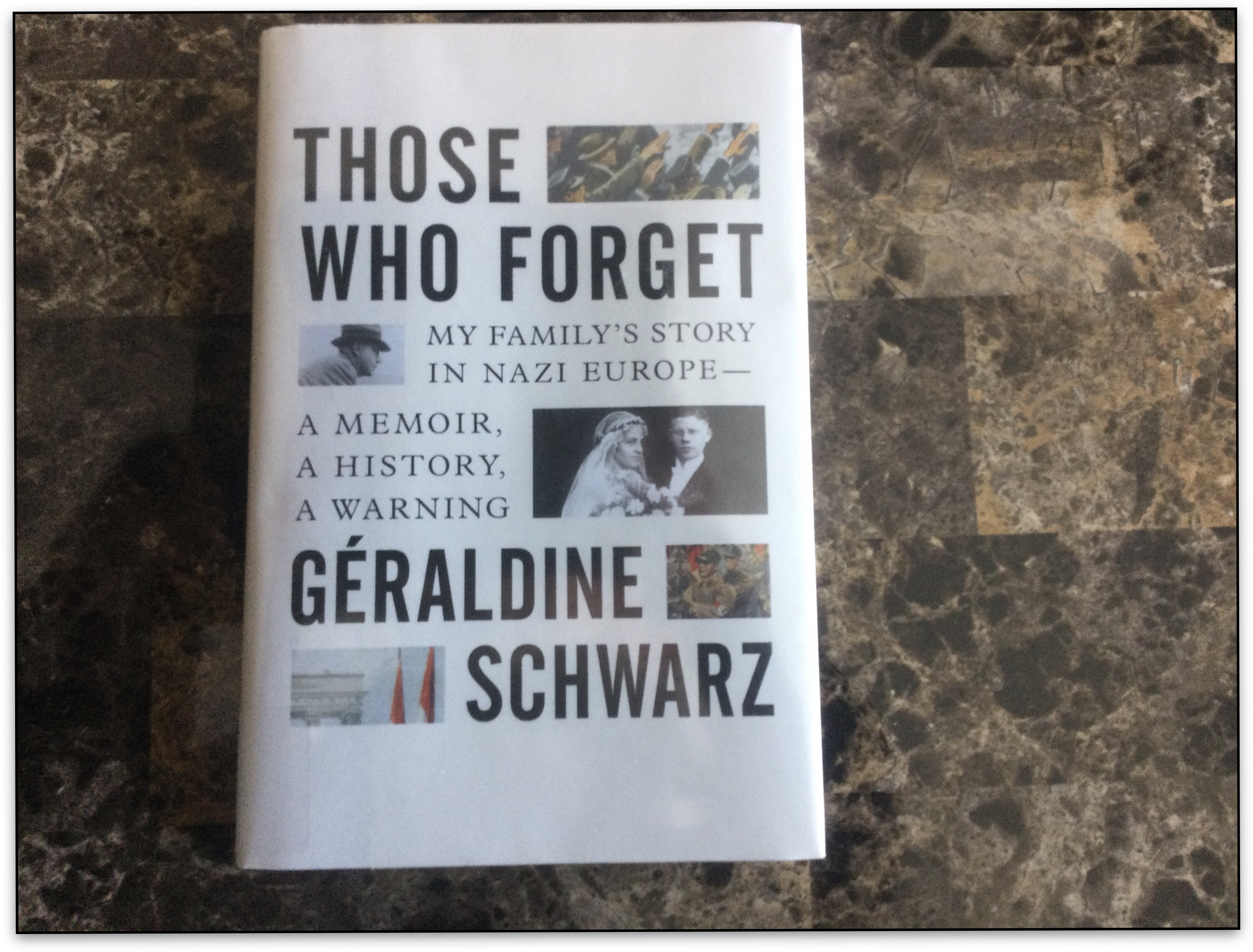
A young French-German journalist offers a thought-provoking analysis of the problems of dealing with war crimes and crimes against humanity- of individuals, groups, and entire nations. Born long after WWII, she delves into her family history only to discover Nazis, Nazi collaborators and fellow travellers, then expands from this perspective to explore how various individuals and nations have come to terms with their dark past. This book thus joins a host of others analyzing the factors leading to the Nazi atrocities, and the consequences, but from a rather unique angle.
The historical facts laid out in this context are far more detailed and interesting than anything taught in my youth, and Schwarz emphasizes the importance of accuracy and honesty in history teaching in the process of healing of nations. The more than half-century of Germany’s collective retrospective self-examination stumbled many times but lead to a modern democratic state, though now threatened again by neo-Nazism and extremists.
A friend once commented to me that Germany has satisfactorily acknowledged and atoned for its dark past of war crimes and crimes against humanity, whereas Japan has not. But that reflects a slanted view (and teaching) of 20th century history. Swartz points out that almost no nation that engaged in war in that century is free of justified accusations of atrocities and war crimes. Britain selectively bombed civilian areas of German cities; the United States dropped atomic bombs on innocent Japanese; Austria, Italy, Vichy France, Poland and Czechoslovakia all cooperated with Nazis to round up Jews for the gas chambers; Stalin sent millions to their deaths in Siberia. After WWII, almost every Eastern European state engaged in some form of ethnic cleansing. International norms of decency were flaunted by Britain in India and Egypt, by France in Algeria, and by Japan in Korea, and all have thrived in cultures of denial.
I smugly noted that Canada is barely mentioned-until I reflected on our criminal treatment of aboriginals in an earlier era, and the more recent but less lethal shameful treatment of natives in residential schools. Those troubling aspects of Canadian history were nowhere to be found in my high school history texts.
The writing is straightforward humourless prose as befits the subject matter, with many quotes from the author’s interviews. She paraphrases Norbert Frei to remind readers that “if we cannot know what we would have done, it does not mean that we do not know how we should have behaved. And should behave if it ever happens again.” I read the 2020 translation that must have been updated from the original 2017 German edition as there is discussion of a 2019 U.N. vote.
This is at once a more personal and more global assessment of the psychology of justifying evil actions than is Hannah Arendt’s Eichmann in Jerusalem. I rather appreciated its fresh account of many aspects of history that are often still totally ignored.

 The Passionate Reader