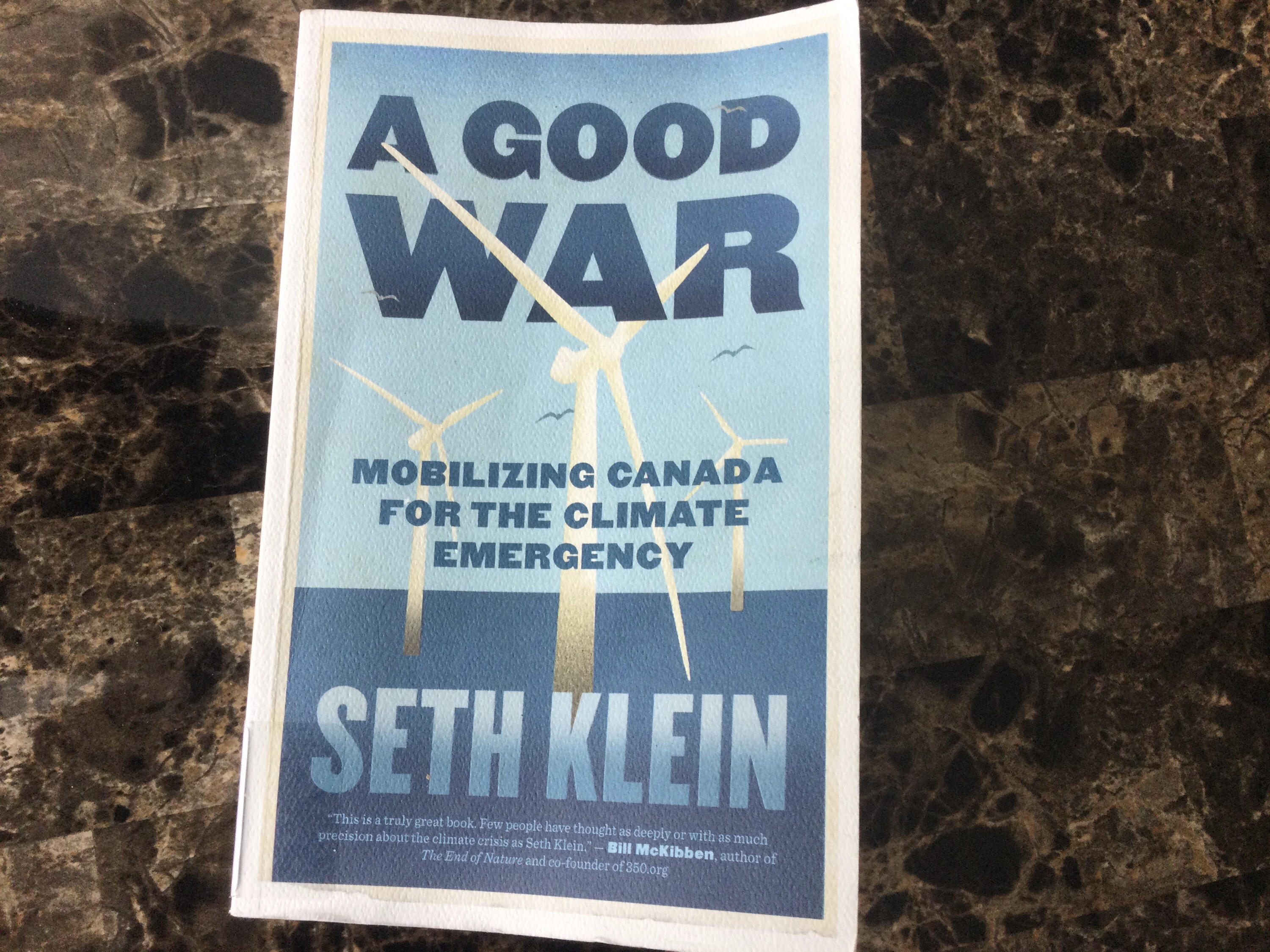
The Vancouver-based professional social agitator and author uses the analogy of what rapidly changed in our political, cultural and industrial landscape during WWII to argue for what needs to change as we face the climate crisis. And he goes about it in a very persuasive, knowledgeable, and scholarly way. By way of background he is a 1960s U.S. draft-dodger, an adjunct professor at Simon Fraser University, a leading member of the Canadian Centre for Policy Alternatives and the brother of the equally well-known agitator- author Naomi Klein. (Having been one, I can assure readers that the title of adjunct professor is almost meaningless with no salary and minimal teaching obligations in exchange for the title.)
The Introduction reads like the enthusiastic sermon of an evangelical preacher building up to a climatic altar call. But it is a call we all need to take seriously, and he leaves no room for counterarguments as he methodically builds the case for massive changes in every aspect of our lives to combat what he calls the climate crisis or emergency, not the less alarming term “climate change.”
Appeasing the Canadian Association of Petroleum Producers powerful lobbyists and untrustworthy liars is likened to Anthony Eden’s appeasement of Hitler in1939 with the claim of achieving “peace in our time.” Ads for cars running on fossil fuels are likened to past ads for tobacco products and he reasonably asks why they are not curtailed or even banned in favour of ads for electric vehicles. The results of many public opinion polls, some commissioned by the author, show that the public is far more willing to adopt massive changes to combat this crisis than are our current politicians to institute them. We may be close to a Malcom Gladwell tipping point when the public will demand the changes needed. Objections to the major upheavals necessary based on job security, inequality and social justice issues are answered persuasively.
The establishment of many Crown Corporations, the requisitioning of assets and the social cohesion that developed rapidly to gear up to the challenges of WWII are used as examples of what is needed and likely to happen if we can unite to face this challenge. Besides guaranteeing good jobs for oil patch workers as honouring the rights of aboriginals, his many recommendations would certainly guarantee full employment for all lawyers.
The basic message: “if something that needs to happen isn’t happening through the market, at the scale and speed the emergency requires- then through our governments- we can and should damn we’ll do it ourselves.”
I was surprised that nuclear power as a source of clean energy is barely mentioned, that the major threat posed by melting of Arctic tundra and glacial ice is totally neglected and that the problem of farm ruminants farting huge quantities of methane into the atmosphere is glossed over. (I read somewhere that this latter problem can be almost totally eliminated by incorporating a very small amount of some seaweed component into their diets!)
An epilogue goes some way into demonstrating how the Covid pandemic has massively and quickly shifted attitudes, norms and practices, uniting us in a vital fight in ways analogous to what we also need to deal with the climate crisis.
Minor quibbles. The human spellchecker failed to correct the cyber spellchecker in talking about “Second Would War.” On the same page, the U.S. is said to have variously entered the war in December 1940 and in December, 1941.
A sober message that needs to be taken seriously. Not a fun read but an important one for politicians, economists, social scientists, and academics. And anyone concerned about the future of their grandchildren.
Thanks to a reviewer in The Globe and Mail.

 The Passionate Reader