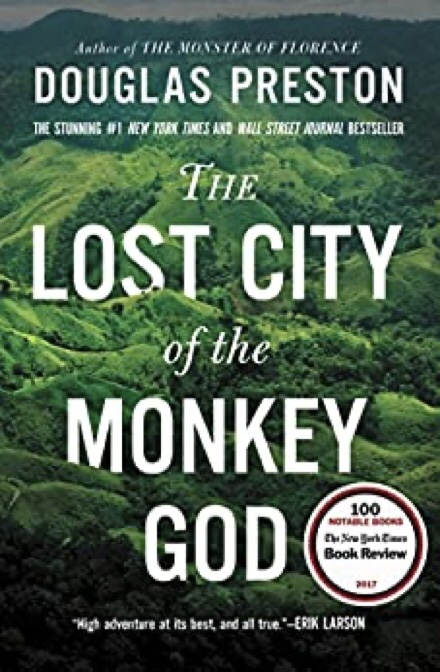
Because of a chance 1996 meeting of the prolific novelist with a scientist exploring ancient ruins, he joined a 2015 motley crew of archaeologists , anthropologists, photographers, film artists, and adventurers to explore the ancient buried city rumoured to be the home of an extinct Honduran people deep in the jungle of the Mosquito region. His previous writings include articles for The Atlantic, The New Yorker, and Harper’s, as well as dozens of novels, most featuring the FBI agent Sargent Prendergas.
The harrowing adventure, working with the changing unstable Honduran political regime eventually lead to what they claim to be the long-lost City of The Monkey God in the world of narcotic traffickers, infested with killer snakes, poisonous vegetation and deadly insects. Their discovery, the exact location of which they try to keep secret to prevent looting of priceless ancient artifacts lead to controversy and scorn from parts of the academic archaeology word, some of it no doubt driven by professional jealousies and shifting political allegiances in the unstable corrupt world of Honduran politics.
The science of mapping the vast area aided by helicopter-mounted Lidar (Light Detection and Ranging) technology is interesting. The explorers almost all got infected with some form of the potentially lethal protozoan, Leishmania, from sand-flea bites, requiring treatment with the toxic drug Amphotericin B. But this did not stop some of them from returning for more artifact recovery.
Although the civilization uncovered may have rivalled that of the Mayan prior to 1500 A.D., it quite suddenly disappeared shortly thereafter, likely largely because of smallpox introduced by Spanish explorers.
The speculations about the meaning of the suddenly destroyed ornate artifacts, and the religious rites of the people, including human sacrifices, are confusing even to expert archaeologists, and will be of little interest to most English bibliophiles. And there is far too much hype in the description of the findings as the author gets caught up in his own enthusiasm. Incredible, outstanding, of supreme importance, astoundingly, staggering, breathtaking, and spectacular, are just a few of the overworked descriptors. The maps and photos at the back are far to small to be of much use. The description of the vastly overgrown city reminded me of what Alan Weinstein described in The World Without Us, and in many ways vindicates his predictions in that book.
By far the most interesting and immediately relevant part of this account is Preston’s thoughtful prescient analysis of the eternal risks to humankind from pandemics, written before the outbreak of COVID-19. He is particularly concerned that the combination of increasing population density, travel, and global warming has lead to deadly variants of leishmania spreading around the world in both humans and animals. And there is no prospect for a vaccine for this deadly infection.
This is an interesting travelogue by a dedicated adventurer that is also a good history lesson and a stark prediction about the future of our battles with dangerous infections.
Thanks, Isla

 The Passionate Reader