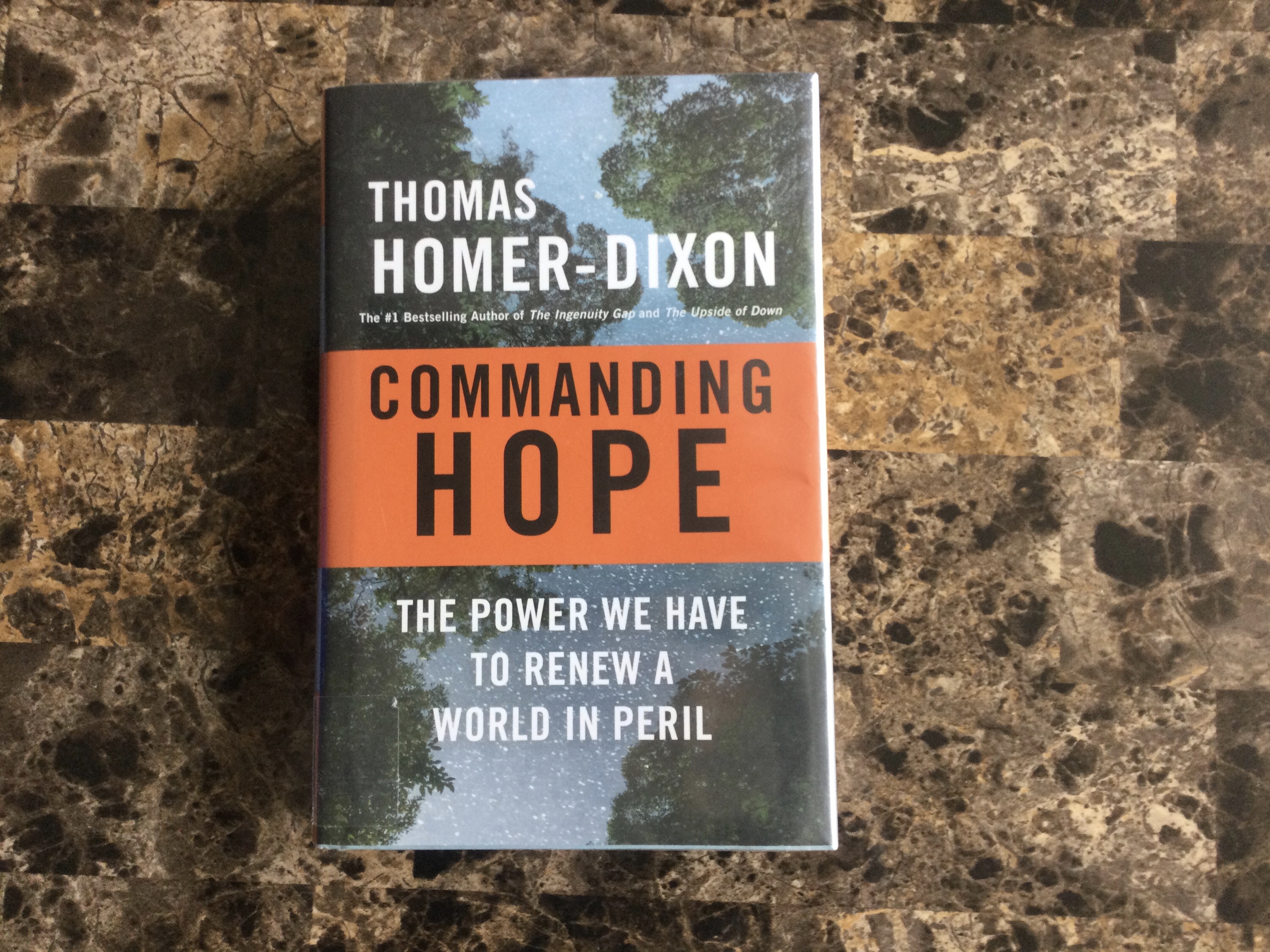
Canada’s foremost deep thinker about global issues offers his unique take on the climate crisis, geopolitical instability, inequality, and our psychological adaptation to current threats, from his perch as a professor of Environmental Science at the University of Waterloo. He provides wide-ranging references to historical events, classic literature (his discussion of and analogies to J.R.R Tolkien’s Lord of the Rings are delightful), social science’s insights, and politics as well as environmental threats.The interspersed personal revelations about his past working in the oil patch and travelling throughout Europe, Asia and Africa and the sometimes profound questions of his young children are welcome diversions from the heady discussions. With collaborators, he has developed ‘tools’ such as the Worldview-Institutions-Technology loop, the ideological state-space concept, Mindscape, and the Cognitive-Affective Map to analyze our responses to various threats and what we can do as we face an uncertain future. Some of these concept tools required rereading for me to get my head around, as they seem like arbitrarily derived insubstantial dissection and reassembly of personalities and outlooks on first reading. It is easy to get lost in the deep philosophical discussions about the nature of time and the boundaries of moral honesty.
The almost universal assumption of economists about the necessity and desirability of growth is brought into question and the prevalent consumer society culture with the view of humans as ‘little more than walking appetites’ with a need for more of everything, is trashed. The need to claim agency as citizens of the world to unite for needed changes in spite of our vast political, cultural, religious and philosophical differences is emphasized.
Referring obliquely without names to Peter Theil’s plan to escape from climate disasters to a vast safe estate in New Zealand and Elon Musk’s equally selfish hopes of escaping to Mars, Homer-Dixon writes: “Being at the end of the lifeboat furthest from the leaks doesn’t mean winning the game; it just means having more time to observe the horrible process of loss before one is engulfed in turn.”
What Malcolm Gladwell calls tipping points, Homer-Dixon calls multipliers or ‘social earthquakes’. He holds out little hope for any rescue from our plight by Silicon Valley types with their blind faith in technology.
I am slightly more optimistic than him about the abilities of techno-optimists to at least go some way to mitigate some of the most challenging problems we face. I have a recurring fantasy of mass-producing, with an international crew of bright biologists, engineers, and materials scientists, some genetically-engineered chlorophyll-like organic compounds that will snag gigatons of carbon dioxide out of the air and, using only the sun’s energy, convert it into potable water, usable energy in the form of glucose, and oxygen. I imagine these being deployed on rooftops around the world and on the surface of vast arid deserts. Or sometimes in my dreams we are using huge vats of cultured chlorophyll-containing Cyanobacteria to do the same thing. My son suggests that using drones to precision-drop billions of weighted tree saplings on to clear-cut forests would do the same thing more naturally, albeit with more delay.
With a much more scholarly approach and rigorous analysis, the message from this book is similar to that from Seth Klein’s A Good War. They make good companion reads. Although this is a sobering, important and challenging message, it is somehow an upbeat optimistic assessment of possibilities for united action. Highly recommended.
Thanks, Pat.
.

 The Passionate Reader