.
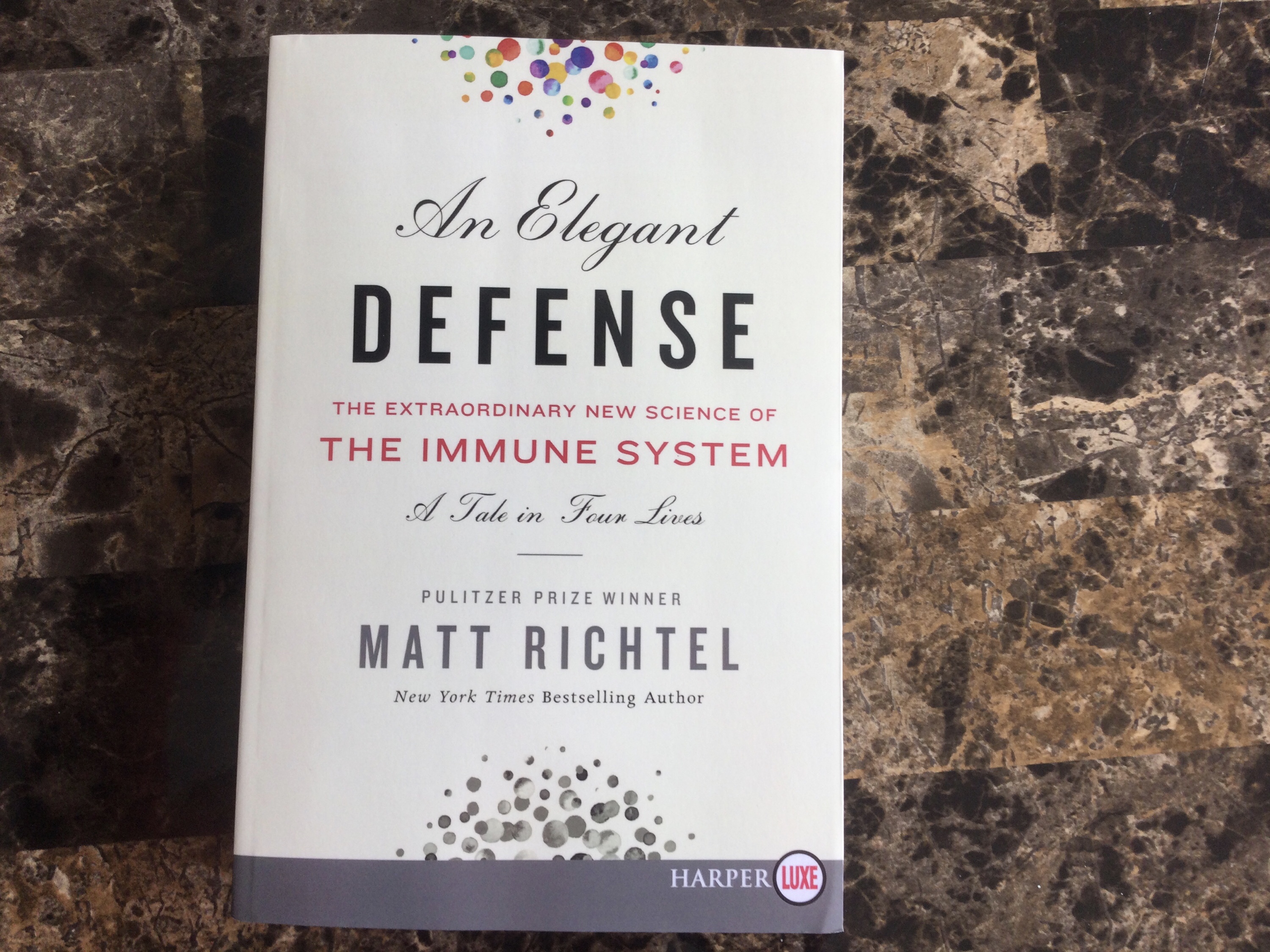
An interesting layman’s review of discoveries in the world of immunology, this well-researched tome by a New York Times columnist was a Father’s Day gift. Using almost entirely military analogies, the complex players protecting and sometimes disrupting the “Festival of Life” are attributed intentionality and the ability to calculate mathematical odds, in their efforts to protect us from infections, injuries and cancers.
The life challenges of several friends of the author who struggle with a cancer, HIV, and various diseases caused by the participants of the immune system which turn out to be traitors causing autoimmune diseases provide the framework for the discussion. The popular myth about needing to strengthen the immune system, as though it is a unitary structure, is thoroughly debunked. The popular hygiene theory to explain the rising prevalence of allergies and autoimmune diseases in western societies is given extensive support, even if it has not been indisputably proven. Like James Hambin’s Clean the critical role of interactions with beneficial microorganisms is discussed in detail. There is considerable overlap with Matt Walker’s Why We Sleep in the discussion of the deleterious effects of stress and sleeplessness, and with Barbara Ehrenreich’s Natural Causes, in documenting the immune system’s rogue promotion of some cancerous growths.
Citing the findings of several Nobel laureates and interviewing such luminaries as Anthony Fauci, the research is generally enlightening. But the discussion of vaccination was unfortunately written before the advent of Covid-19 and the game-changing development of mRNA vaccine technology. And the less scientific advocacy of stress reduction, meditation, and multivitamin use in places borders on pseudoscience with the delightfully named psychologist, Dr. Malarkey discussing the harmful effects of stress without defining it.
The writing is colloquial in style and was generally quite easily understood by me. But I am not the typical non-scientific reader, as I spent years prescribing many different manoeuvres to prevent transplant recipients from rejecting their livers, including many of the drugs and monoclonal antibodies discussed here. It seems to me that the major difficulty with the whole book is that the author has failed to think about what his target readership should be in advance. Much of it is either overly simplistic or confusingly complex such as this: “CTLA-4 and CD28 both bind to ligands called B7-1 and B7-2 -also known as CD80 and CD86.”
A long digression into an introspective autobiography contributes little to the message, and calling irritable bowel syndrome an autoimmune disease is a stretch. There are spell-checker errors such as “infection point” when, in context, it clearly should be an inflection point.
Conveying many interesting insights and facets of biologic interactions, this book will be of interest to some, but just confusing to many.
Thanks
Andra

 The Passionate Reader