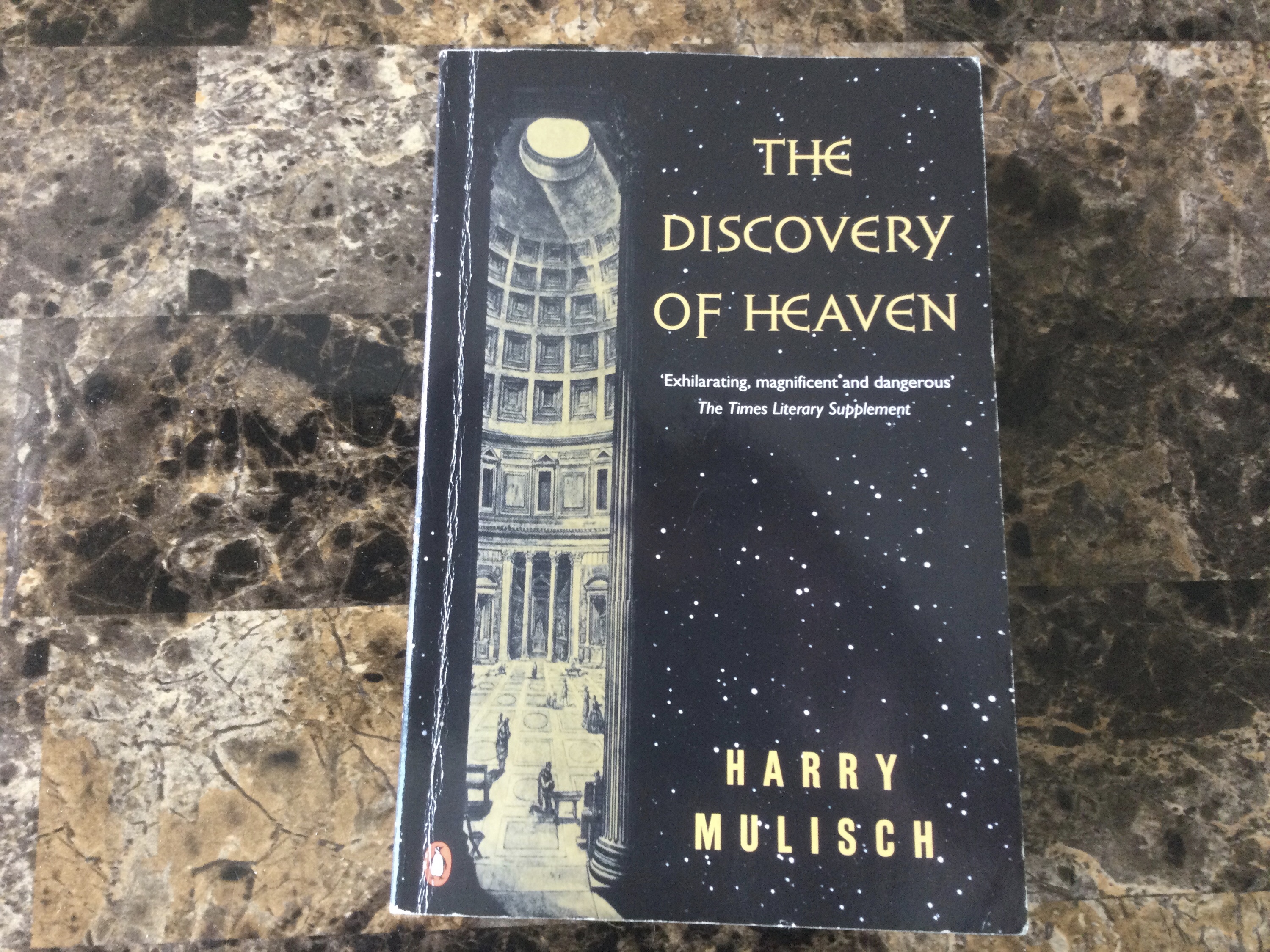
After reading the seven page prologue to this Dutch novel, I thought of George W. Bush’s comment about Donald Trump’s inaugural speech: “Well, that was some weird shit.” The dialogue between characters, none of whom appear to be human or earthbound, makes the Book of Revelation seem like straightforward narrative. Fortunately, the story steadily improves with real life believable characters interacting. But the same plotting deities appear again later and their schizophrenic conversations and plots recur several times, including one long monologue by a hermit talking to a crow, and Lucifer dictating books of self-fulfilling prophesies to Francis Bacon. The deities who work for “the Chief” apparently are not all-powerful , but do manage to evaporate a drunk astronomer in the middle of the night with a meteorite strike when he is dangerously close to finding the singularity of the Theory of Everything, uniting quantum physics with relativity via string theory.
Set mainly in Holland in the 1960s to 1980s, Max Delius an orphaned Jewish Dutch astronomer and Onno Quist, a flamboyant egotistical socialist/Marxist aspiring politician become bosom buddies after a chance meeting in spite of gaping differences in their outlooks. The latter’s unanchored vague spirituality and mysticism is the polar opposite of Max’s worldliness but they develop a tight bond, even sharing the love of an ill-fated concert cellist. Death stalks many characters in their prime.
Paradoxes, metaphors, symbolisms, and analogies pop up in long soliloquies and conversations, with many bleak themes of meaningless existentialism; there was no entity called time before the Big Bang so that could not have occurred at any point in time; God who created himself from his creation had to exist before he created anything. Elliptical allusions to ancient classical literature, music, astronomy, mathematics and architecture and their interconnectedness seem at times to simply serve to show off the author’s vast obscurantist classical knowledge, as do the many pages taken up in describing the history, geography and symbolism of dozens of tourist sites in Venice, Florence, Rome and Jerusalem. The quest for interpretation of the Phaistos disc writing remains unsolved. In the final 150 pages, Onno and Quentin, who may or may not be his son, reach for heaven by a scholarly search for the Ark of the Covenant and the tablets of the Ten Commandments in the Sanctus Santorum in Rome, but that quest ends with the visual hallucinations of a raving lunatic in Jerusalem
The few main characters are easy to keep track of and colourful but the many secondary players can become confusing. The plot is ingenious-at least the parts that are made for real characters- but there are far too many highly improbable coincidences.
I completely lack the intellectual equipment to appreciate or understand much of this story, although the human characters are realistic and some of the insights are interesting. But if there is some profound universal truth hidden here, I completely missed it. Good luck to anyone trying to plumb it.
Thanks, Linda, but you overestimated my capacity to understand and enjoy this one.

 The Passionate Reader