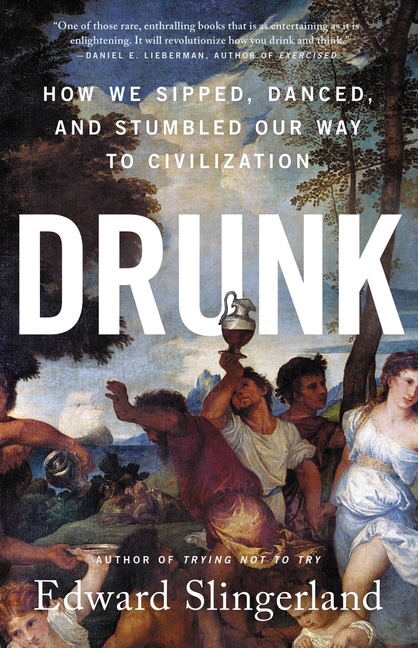
I am not sure how or when I heard about this book and put it on Hold at the OPL, but I am am sure I was not drunk at the time. The UBC professor of Philosophy, a self-described hedonist, gives a very balanced and well-organized account of the role that alcohol has played throughout the history of Homo sapiens.
Likening the role of the cold, rational, calculating and late developing prefrontal cortex of our brains with the logic of Apollo and the more emotional and pro-social older areas of our brains with the hedonistic Dionysus, Slingerland fits alcohol (and other intoxicants) into the history of civilizations and documents it’s critical role in promoting creativity, culture and community. Drawing on extensive literature, evolutionary science, psychology, and anthropology, he makes the convincing case that we, as life forms uniquely cursed by self-awareness, would never have developed communities of trust, creativity, collaboration, and unique institutions without the help of intoxicants like alcohol to temporarily take the prefrontal cortex offline, and allow us to develop social bonds.
“Although they did not enjoy the benefits of modern neuroscience or social psychology, cultures throughout time and across the world implicitly understood that the sober, rational, calculating individual mind is a barrier to social trust.”
Far from an unapologetic proponent of drunkenness, the vast harm that alcohol use and abuse does is detailed and put in a longterm perspective, and the views of abstainers are carefully respected. The dangers of the relatively modern developments of distillation of high-alcohol-content spirits and drinking separate from socialization are emphasized. Alternative means of achieving the endorphin highs that ethanol induces such as high energy charismatic religious rites or meditations are extensively discussed.
There is no discussion of the medical concepts of differentiating the physiologic harms such as alcoholic liver disease from the concepts of addiction and dependency. In my past life, I dealt with many people who developed alcoholic liver disease because of high susceptibility (for some women, two standard drinks per day is a risk) but would not be considered to be alcoholics and conversely, many alcohol abusers to the point of risking withdrawal symptoms who never developed significant liver disease. There is no mention of the rare autointoxication syndrome when some teetotallers can become drunks because of fermenting microorganisms in their stomachs. I am not a neuroscientist, but I suspect that the description of the human prefrontal cortex as a brake on creativity, culture, and community development is an oversimplification, given the enormous complexity of neuronal connections.
I vaguely recall one of my pharmacology professors discussing the results of his experiments with offering lab rats various flavoured alcoholic drinks more than fifty years ago. If I recall correctly (a big IF), he concluded that at least some strains of lab rats chose their drinks by taste rather than by alcohol concentration. I like to think that the taste is the main reason I occasionally can spend three hours in our balcony lounge chair with a good book, two fingers of a peaty single malt Scotch and a few drops of water. (Oh, and two frozen whiskey stones.) Pleasure for pleasure’s sake is not a sin, and, anyway, some pleasures are not worth foregoing for a few extra years drooling in diapers in a locked ward.
This book is a delightful, informative, thought-provoking, easy read. Highly recommended.

 The Passionate Reader