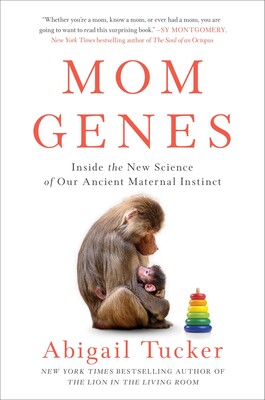
A Connecticut Yankee reporter and mother of four delves into the complex science of the influences of offspring on mothers and visa versa from conception to adulthood. Interviews and visits to numerous labs around the world and hundreds of scientific reports of studies on this relationship, not only in Homo sapiens but in many other mammals and even insects lead to startling conclusions, many of them counterintuitive and new to me. For example, an embryo sends cells into the mother’s circulation to permanently set up shop in various organs including her brain, altering her brain anatomy and chemistry in measurable ways, thus creating a form of chimerism. Reading about details of the changes in hormones in pregnancy and the roles played by the placenta was like an update to my med school embryology and endocrinology lectures in the 1960s, and the complex neuroanatomy and neurochemistry changes in pregnancy were almost entirely new to me.
Many of the social science studies cited can be criticized for bias by unblinded interpreters, questionable statistical analysis, equating correlation with causation, over-generalization from one species to another, and non-reproducibility. Nevertheless the many startling little-known indisputable facts will hold readers attention. Roe deer and brown bears “will not reproduce in the first place unless there is the right amount of food around. Their reproductive tracts feature a nifty safety-deposit-like structure called a ‘uterine crypt’ where they can stash their fertilized embryos indefinitely in a state of suspended animation, not progressing in pregnancy until the berries on the nearby bush ripens or the environment otherwise sweetens to meet their standards.”
Interspersed with the science are hilarious personal anecdotes relating to her own pregnancies and family life with some very serious topics such as postpartum depression discussed with great sensitivity.
Never directly discussed, the question of who is making decisions which seem to be often be made solely by a combination of genes, proteins and environmental influences raises the age-old question of free will, and the philosophical discussions of hard determinism vs compatabilism. Do any of us make decisions at all?
The latter chapters disappointed me a bit with less science and more discussion of her own stressful fourth pregnancy and rambling advice on child-rearing in various circumstances that is like an updated Dr. Spock.
The straightforward prose is sprinkled with quirky analogies and metaphors (she describes her husband as “a celebrated lunch box chef whose diaper-changing art borders on origami”), and should be easy for non-scientists to understand.
I learned a lot and enjoyed this book, always in awe of the wonders of nature. Mothers and mothers-to-be would probably appreciate it even more.
Thanks,
Bob McDonald (of CBCs Quirks and Quarks podcast.)

 The Passionate Reader