I started into this book because it is to be discussed at our book club, without realizing that I would miss that meeting because of another commitment.
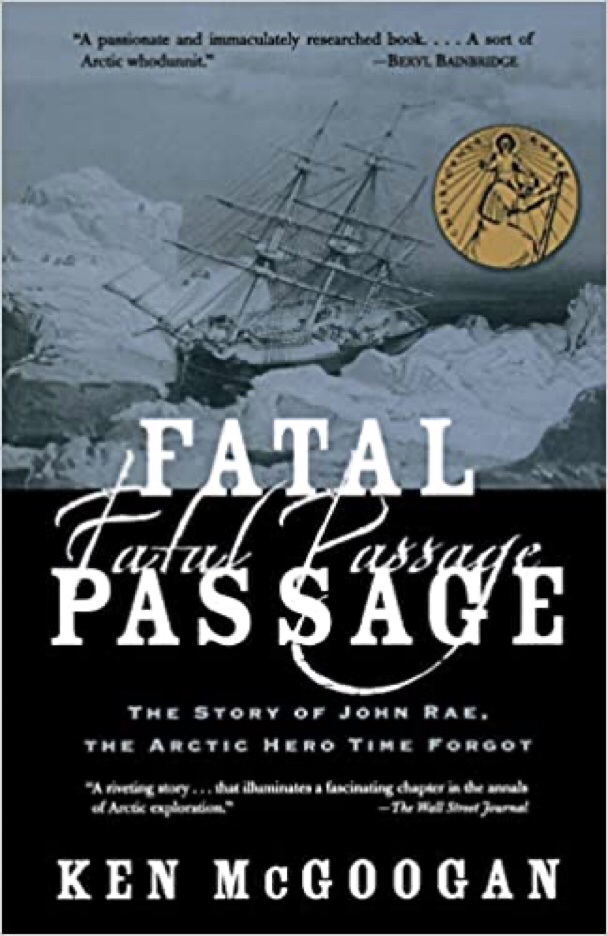
A Calgary writer makes a valiant and quite compelling effort to restore the historical honour of the Orkney Scot, John Rae, as the Arctic explorer and adventurer who, in the 1840s and 50s, was the first to discover not only the Northwest Passage but to pinpoint the area of the Franklin expedition’s shipwreck and the fate of its members. That report of his, leaked to the British public, included evidence of cannibalism by the starving crews. The elite racist English noble classes encouraged by John Franklin’s widow refused to believe the evidence Rae provided from encounters with the native Inuits, and other adventurers and cartographers laid claim to the maps of the vast area that Rae had first detailed. The British Admiralty was in constant conflict with the more successful explorers of the Hudson’s Bay Company, Rae’s employer. Even racist Charles Dickens got into the act, describing the Inuit natives that Rae relied on as unreliable savages who probably killed the crew members of the Franklin ships, the Erubus and the Terror, although he probably never met an Inuit.
This documentary screedwas written thirteen years before the wrecks of the two ships were discovered; those discoveries completely vindicated the conclusions made by Rae sixty years earlier.
There are endless hard-to-believe stories of incredible hardship and endurance, long treks on snowshoes, and near-disasters but also remarkable loyalties and friendships. Few readers unfamiliar with the vast north will be interested in the minutia of confusing details of the geography and endeavours and the five faint maps in unreadable small print are of little help. Only two of the maps are readily relatable to the accompanying text. The exact mileages covered by the explorers, stated as fact, particularly in the Epilogue, are hard to accept as accurate, given the crude instrumentation of the day; they seem more like estimates.
Part of the difficulty in accepting John Rae’s account was the ingrained biases of the British aristocracy; as frequently happens, the history written by the powerful politically-connected was blatantly distorted to protect their interests, the truth be damned. But part is also because “Rae wrote so awkwardly. He had mastered the rules of grammar, more or less, but lacked style and flair; he had no sense of composition, of narrative.” I am tempted to apply the same characterization to the author of this humourless and unnecessarily detailed historical account.
This book is undoubtedly of great interest to historians of the north, and is very educational, but is not one that most readers would enjoy, even in Covid lockdown.

 The Passionate Reader