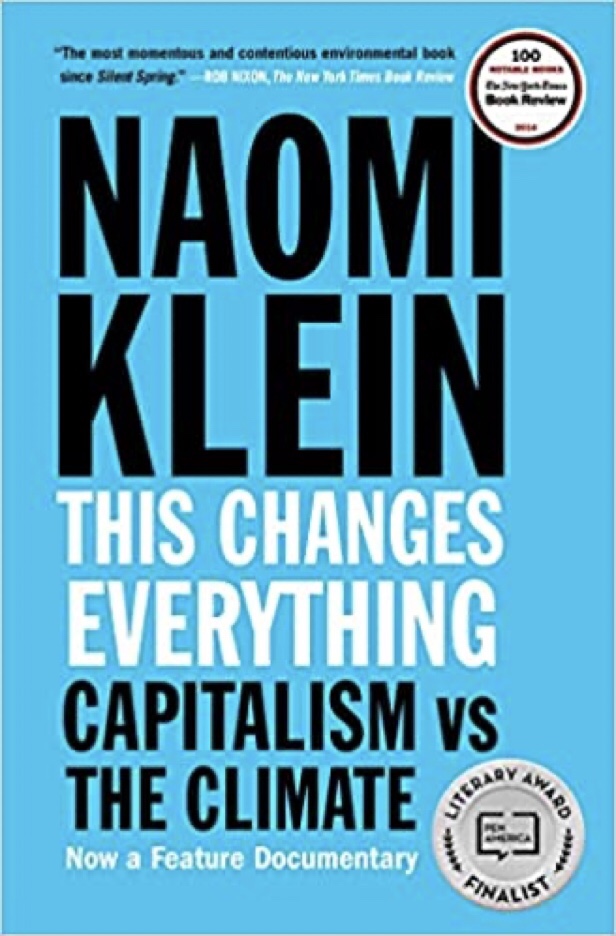
Political, economic and cultural developments, particularly in the United States, since this book was published only six years ago make much of it already seem hopelessly outdated. The Vancouver author and social activist provides an encyclopedic and depressing review of where we were six years ago in global efforts to combat climate change. It is much more depressing now when we consider that very little of what she forcefully documents we absolutely need to do “by the end of the decade” i.e. by 2020, was actually done.
Of hundreds of environmental organizations supposedly working to limit global warming, many are funded in part at least by fossil fuel companies and some are extending drilling rights on nature preserves and appointing extractive industry moguls to their boards. Klein’s skepticism is pervasive and there are great example of duplicity and false claims by many in the extractive industries. I particularly appreciated the irony of Rex Tillerson, then CEO of Exon-Mobile, opposing fracking near his multimillion dollar mansion because it would lower the value of the real estate in the area.
For the first two sections of the book, it seems that Klein is anti-everything- capitalism, consumerism, free trade, entrepreneurship, individual wealth, and modern technology. Her analysis clearly documents that most so-called solutions advocated or legislated by politicians, technocrats or business leaders like Richard Branson are mainly for “green washing” and fail to meet any meaningful targets. Her most scathing rebuke is directed toward the tech geeks who claim to be able to interfere more with nature, not less, as in geoengineering a global sun block. The industry claims for natural gas as a bridge from oil to renewable energy sources is exposed as a sham, and even nuclear power generation is claimed to be unhelpful, not because of the minuscule risks of radiation, but because of the amount of fossil fuel energy used to mine uranium and to convert limestone into concrete.
But in the third part, after about page 348, she becomes more upbeat with copious documentation of the potential for radical positive change-if and only if the tipping point and actions come from the common people around the world, not from billionaire philanthropists, corporate leaders or politicians. And since this book (and the documentary film based on it) was produced, there has been some progress, witness the cancellation of the Keystone XL and Northern Gateway pipelines as a result of such public protests, and even public protests against new coal mines in autocratic China.
‘Socialism’ has become a derogatory almost meaningless word, particularity in the U.S., applied by Republicans to any form of government that they don’t like. But the experience of Nordic cultures that tackle income inequality and climate issues with wide social support systems and limitations on unfettered capitalism should give all of us reason to reconsider radical cultural and political changes as we face the prospect of an uninhabitable world.
The authors self-assurance that she has all the answers to the massive problems we face as a species can become grating, but her arguments and recommendations are compelling, logical, and difficult to refute.
A couple of great quotes: “For a couple hundred years we have been telling ourselves that we can dig the midnight black remains of other life forms out of the bowels of the earth and burn them in massive quantities, and that the airborne particles and gases released into the atmosphere….will have no effect whatsoever. Or if they do, we humans, brilliant as we are, will just invent our way out of any mess we have made.”
“Step one for getting out of a hole. Stop digging.” (Not very original, but very appropriate.)
Along with Rachael Carson’s Silent Spring, Al Gore’s An Inconvenient Truth, and the author’s brother, Seth Klein’s A Good War this tome provides a classic warning that we should all take seriously.

 The Passionate Reader