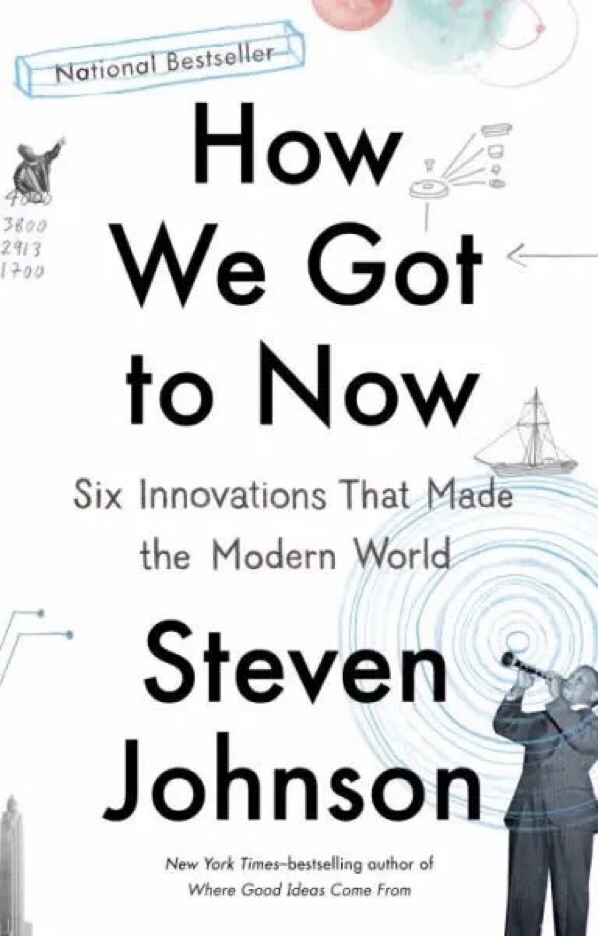
The well-known American author of thirteen books, mostly about the history of science, divides this one into six chapters entitled Glass, Cold, Sound, Clean, Time, and Light. His wide-ranging knowledge and unique insights always provide interesting perspectives and background on diverse subjects and inventions that we take for granted without questioning their origins. I have read his 2006 The Ghost Map, and his 2021 A Short History Of Living Longer and enjoyed them both.
All the chapters here document important and unexpected historical trends from simple inventions. In that respect the book could be entitled Unintended Consequences of Important Innovations, or perhaps The Butterfly Effect of Important Innovations, after the chaos theory aphorism, referenced several times, of a minute localized change (like a butterfly flapping its wings in California) in a complex interconnected system, having huge effects elsewhere (like causing a hurricane in the Atlantic). The invention of glass lead to the development of spectacles, telescopes, microscopes, and mirrors. The harnessing of cold for storage of foodstuff in ice lead to air conditioners and huge changes in demographic distributions around the world. The invention of sound recording via the phonoautograph and Edison’s phonograph lead to Bell’s telephone, microphones, military use of sonar, medical use of ultrasound, and digitization of music and communication. The Clean chapter lacks a single simple innovation but the need for clean water lead to the development of sanitary sewer systems, and chlorination of drinking water. Contamination of water lead to the germ theory of infectious diseases, first espoused by John Snow, and a huge change in personal hygiene attitudes, and stoked the popularity of public swimming pools. But I think Johnson stretches the connection a bit to argue that this drove radical changes in women’s clothing fashions.
The Time chapter documents the utter confusion of every city and community having their own clocks set to the correct time based on astronomy, before the relatively recent adoption of time zones and the acceptance of extremely accurate clocks based on the very consistent rhythmic oscillations of electrons orbiting around caesium nuclei. In the Light chapter the claim is made that before the development of artificial light, humans generally had two distinct sleep periods in darkness with a significant awake period in between. I doubt that our complex circadian rhythms have changed that drastically in less than 200 years and this claim was not mentioned in Matthew Walker’s 2017 comprehensive Why We Sleep. The discovery of neon and the development of laser are well described, but optimistic use of highly focused light to produce unlimited energy by nuclear fusion has not (yet) borne fruit.
Throughout, Johnson emphasizes that all the innovations discussed were not the result of solitary geniuses having an ah-ah or light bulb moment but the result of slow evolution of ideas in brainy people with a wide knowledge base, i.e. people like himself.
The choice of the six innovations seems arbitrary, and I am sure some readers will think of others that should or could have been included. My nomination for that is the plow. Perhaps Johnson will write a “Six More Inventions That Changed The World” and include it. He is far to young to retire.
A good educational read loaded with little-known historical facts.
Thanks,
Andra via Cratejoy.

 The Passionate Reader