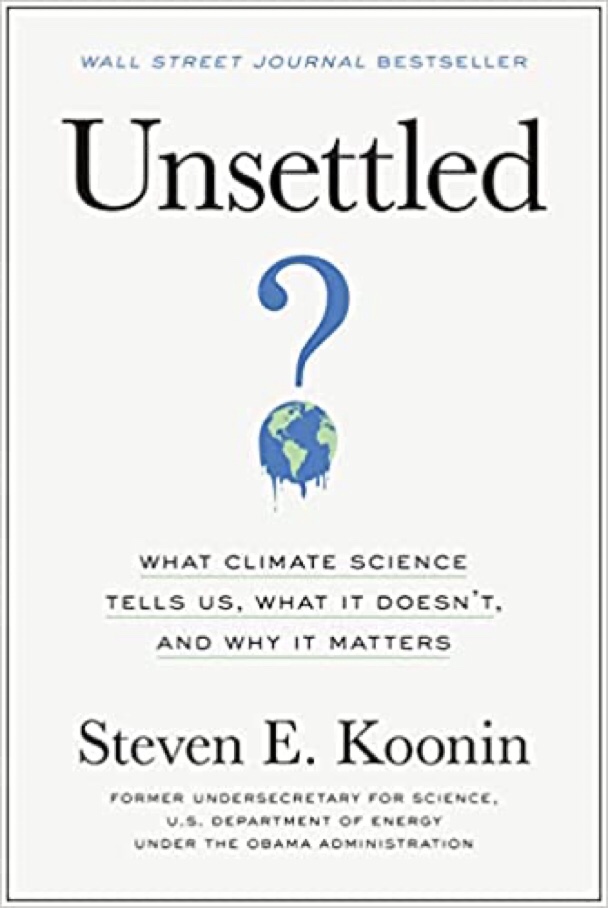
I am not sure what led to my interest in this book other than a general hope to learn more about climate change and the factors that are driving it. And I generally enjoy reading the works of contrarian, iconoclastic writers who challenge what John Kenneth Galbraith called ‘conventional wisdom’ and Steven Koonin certainly does that. He is a theoretical physicist, currently a professor at New York University. In the past he has worked for British Petroleum in their renewable energy division and was a government science advisor in Barrack Obama’s first term, but not in his second term. He never mentions why he left that job, but my guess is that he was fired.
Early on, Koonin makes clear that, at least for him, science is all about the pursuit of factual knowledge, and should be completely divorced from advocacy and persuasion. But surely scientists do have some ethical obligation to advocate for the truths they discover and the implications of those truths as they relate to the lives of others. And he breaks his own rule in Chapter 13 in making suggestions to deal with global warming; specifically, he advocates for funding research into geoengineering and solar radiation management, a strategy that even alarmists about global warming shy away from, because of the unknowable consequences.
In the first few pages, an old aphorism about the distinction between weather and climate is invoked to make the distinction clear. “Climate is what you expect. Weather is what you get.” A trite but important distinction.
There are a lot of indisputable and surprising facts about the limitations of the science of climatology that I found interesting; these contradict the popular narrative, and he emphasizes the changes that are natural and unrelated to human activities. The uncertainty that is integral to the various models used to predict trends and guide policy decisions is documented and bemoaned but seems to lead directly to advocacy for inaction, or at least delay of any meaningful action.
The writing is loaded with acronyms and technically detailed science that many readers will have trouble following and the accompanying graphs seem to sometimes make distinctions of questionable significance. The cherry picking of arbitrary time periods to make comparisons is lamented but is also used to reinforce his arguments.
The author’s undisputed intelligence and self-confidence spills over into annoying arrogance as he seems to think that he, and he alone, has all of the answers to the climate problems that 8 billion others face, none of whom have solved the problem as well as he has. He takes great pleasure in showing that predictions of such luminaries as Mark Carney and WHO experts have been proven wrong with the passage of time, but never acknowledges any doubt about his own predictions. He never fails to mention the positions of considerable influence that he has occupied and name-drops his famous contacts liberally, including a dinner at Buckingham Palace with the late Prince Phillip. Even the About the Author blurb reads like the introduction of a VIP at an awards ceremony, listing his many important appointments.
The valid bottom-line message of this book is advice to be skeptical about how the data on global climate change is presented in the popular media. It is also a good reference work, particularly the 74 graphs that provide valuable data, although some statisticians could probably find fault with some of them.
I cannot recommend this dense, dry book for the general public..

 The Passionate Reader