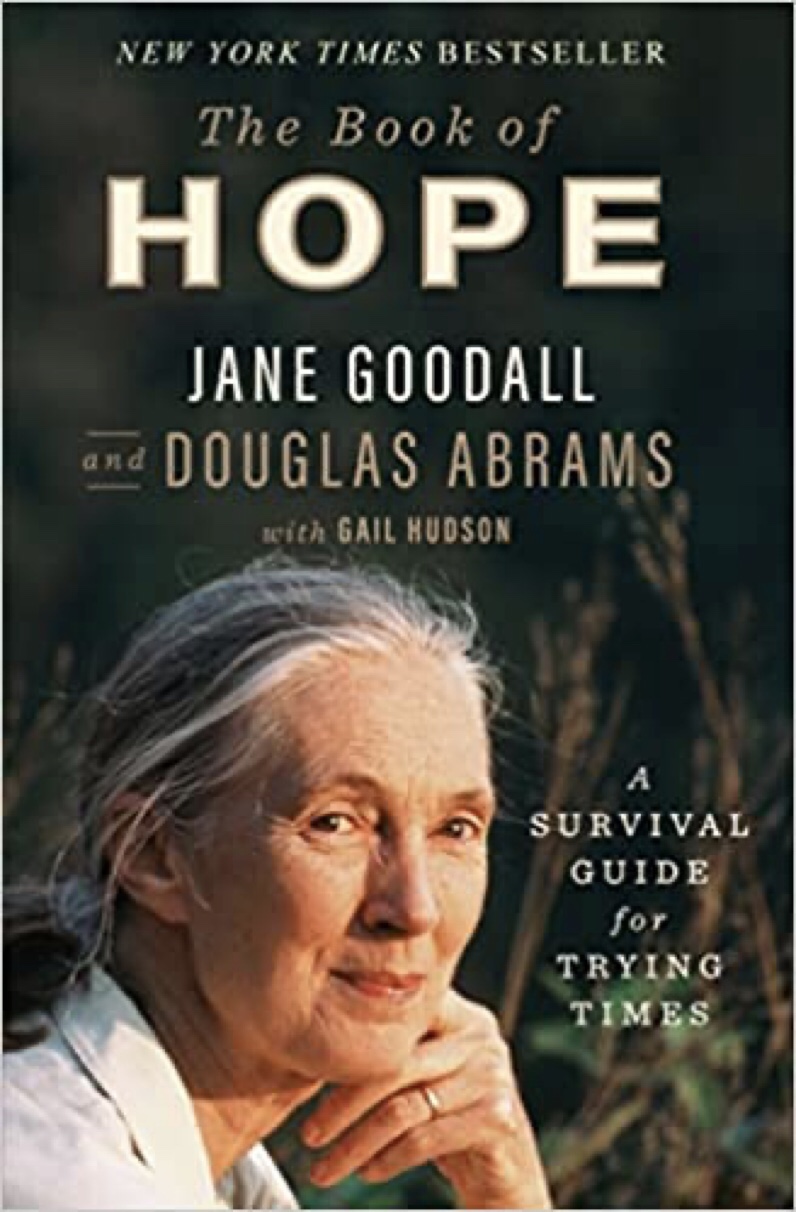
In this largely question-and-answer discourse with an obviously admiring Douglas Abrams, the 87-year-old world-famous conservationist’s intelligence, charisma, and optimism shine through. The format of the book is discussion of Dr. Goodall’s four reasons for hope, sandwiched between a somewhat pedantic thirty-three page discussion of the meaning of the word hope, and a forty-six page selective biography of her life, her work and her beliefs. These in turn are bookended by her brief and personal “An Invitation To Hope”, and “A Message Of Hope from Jane” addressed to the reader.
Her four reasons for hope that we can survive and prosper in spite of formidable problems that she does not shy away from, are: The Amazing Human Intellect, The Resilience of Nature, The Power Of Young People, and The Indomitable Human Spirit. Of these, the documentation of the dramatic effects of the power of mobilized, motivated, and energetic young people working through her thirty year old, international Roots and Shoots program gave this reader the most convincing reasons to hope for a better or at least a survivable future for Homo sapiens. In the Amazing Human Intellect, she makes a careful distinction between intelligence and wisdom. In The Resilience of Nature, she gives readers numerous examples of how plants and animals have overcome near-extinction, often with some help from humans. In The Indomitable Human Spirit, a smattering of history is reviewed to demonstrate howwe have overcome seemingly impossible obstacles in the past.
It would be remarkably arrogant, inappropriate and silly of me to criticize someone of Jane Goodall’s stature, intelligence and integrity. Nevertheless I can take issue with, or at least discuss, some controversial points. Her reliance on aboriginal medicine men and shamans to cure physical ailments seems unscientific, almost anti-scientific as does her nebulous reliance on connecting with a “Great Spiritual Power” outside of herself for strength and courage. In A Lifelong Journey, she abandons science completely in acknowledging a belief in some kind of vague life after death, and perhaps even reincarnation. Her philosophy seems to include a strong belief in human free will, a tenet that many science-minded modern philosophers reject. But, admirably, she refuses to expect others to adopt her nebulous spiritual outlook on life. There are some hints of hyperbole in discussion of climate change and loss of biodiversity. I got no clues as to why Gail Hudson’s name is present on the cover.
The discussion is often unfocused and rambling but is so loaded with keen insights and little-known facts about the remarkable world of nature as to keep the reader fully engaged.
A good read and an interesting biographic sketch of a remarkable primate.
Thanks,
The New Yorker

 The Passionate Reader