In an interesting coincidence, within a couple hours yesterday, I encountered two references to Occam’s Razor, the principle of parsimony first enunciated by the 14th century Franciscan friar, William of Occam. There are several wordings of it, but the most popular is that to explain any phenomenon, the hypothesis requiring the fewest assumptions should be chosen, as it is most likely to be correct. My brilliant friend, Al Dreidger used it in his ‘brain droppings’ to explain the phenomenon of dimorphism in birds and humans. I think Al may have introduced me to it, and I have used it in my problem-solving and writing as well. Then the author of this erudite treatise used it in discussing a strange astronomical phenomenon observed in October, 2017. Both authors have also quoted the Sherlock Holmes’s observation that when you have eliminated the impossible, whatever remains, however improbable must be the truth.
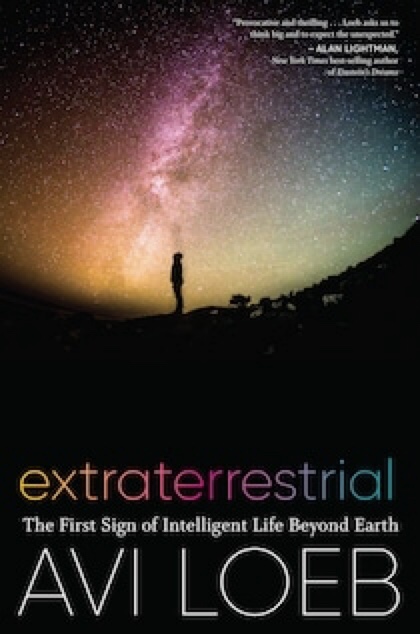
All of the above is a roundabout way of introducing the thinking of the eminent Harvard astronomy professor and author of this scholarly book.
For several days in October, 2017, astronomers tracked a strange object subsequently named the ‘oumuamua, that entered our solar system, carved a smooth arc within it, rotating and tumbling systematically and disobeying the laws governing movement of all known natural objects in space, then sped off back into interstellar space. Most astronomers were confused, but eventually generally agreed that it was not a comet, an asteroid, or a man made piece of space debris. Using Occam’s Razor to cut away the seemingly impossible explanations for it that all need a huge number of assumptions, Loeb gathered evidence for the only other possibility, i.e. that it was, however unlikely, the product of some form of extraterrestrial intelligence. He posits that it was a solar-powered lightsail used to power an alien rocket ship.
His hypothesis and the whole small SETI (Search For ExtraTerrestial Intelligence) community of astronomers has been met with either silence or scorn by most mainstream astronomers. He addresses the issues of fads and blinkered thinking within science generally, and laments that funding is often directed to those studying string theory, extra-spatial dimensions and supersymmetry for which he says there is no evidence, rather than for SETI. He alleges that there are approximately a zeta (1,000,000,000,000,000,000,000) habitable planets in the observable universe. “The scientific truth is not determined by the number of likes on Twitter, rather by evidence.”
Later in the book, Loeb discusses the panspermia hypothesis of the origin of life on earth coming from other planets, and posits Oumuamua’s wager, modelled after Blaise Pascal’s famous wager about God. “Live as if there is, or has been intelligent life in the universe other than our own, and we redefine some of the missions of humanity.”
Loeb has been accused of arrogance and cites a lot of his own discoveries. But he also is careful to include his collaborators and comes across, at least to me, as the inquisitive Israeli farm boy he once was, simply trying to figure out how the world-no, the whole universe- works using all the tools at his disposal.
I cannot claim to understand all of the mathematics and rarified language of astrophysics in spite of Loeb’s frequent use of plain language, thought experiments, and analogies. But I really enjoyed getting his perspective on an important scientific issue, and generally enjoy reading the works of iconoclastic thinkers. I do believe we must have company.

 The Passionate Reader