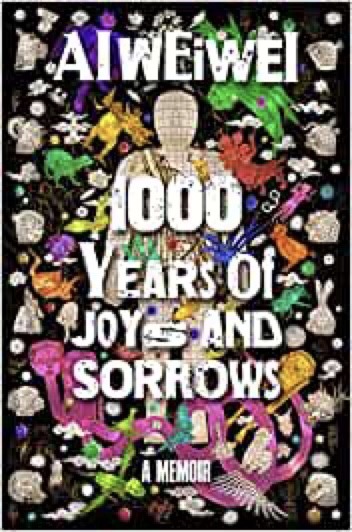
First a confession. Before being gifted this book, I had never heard of the famous Chinese author of this memoir. He describes his occupation as artist but defines art loosely, as he plays roles as poet, writer, sculptor, visual artist, photographer, documentary film-maker, architect, musician, political activist and all-round S.D. His father was apparently an equally famous artist (in pre-Revolutionary China), a friend of Mao Zedong and a leading communist fighting the Japanese occupiers and the Nationalists at one point before becoming a disillusioned critical outsider, and was jailed long before Mao’s 1970s Cultural Revolution that killed 550,000.
The first 80 pages is all family history stuffed with unfamiliar names of people and places, as the author’s father moves repeatedly around China and elsewhere in the pre-revolution years, even becoming a friend of the famous Chilean Communist poet Pablo Neruda.
The author was and still is equally itinerant, travelling around the world to art exhibits featuring his work, and making friends everywhere he goes. While living in New York, American friends included Susan Sontag, Andy Warhol, and Allen Ginsberg. There is no doubt that he is talented in many fields, intelligent, sincere, and devoted to championing human rights everywhere. He was the Chinese collaborator with a Swiss architectural company in designing the Bird’s Nest stadium for the 2008 Beijing Olympics. I rarely read poetry, but some included in the book was quite enjoyable. His work and political views are so characterized by antagonism to everything mainstream as to make him seem to be an anarchist.
His subversive artistic themes naturally lead to conflict with the autocratic controlling Communist Party and his fearless criticism finally lead to his incarceration and silencing without a trial for 181 days in 2011, at the same time that my wife and I were touring China for three weeks. His documentation of the cruelty of the state apparatchiks is chilling.
He must not be poverty-stricken. He describes flying 100 tons of rebar across China to construct a memorial statue to children killed in a poorly constructed state school in the 2008 earthquake. More puzzling is his arranging and funding for 1001 ordinary Chinese to visit an art exhibition in Germany as some kind of symbolic work of art itself. Much of his art, like most of contemporary art, is just confusing to me, Images of a nude man covered in flies, a man chewing on the arm of an aborted human fetus, and of three women and himself standing nude do not inspire awe in me. It seems that if it shocks, it must be art.
The author’s relationship to women can best be described as serial monogamy, with or without the benefits of marriage. It is not clear even in the About The Author blurb, where he is now living-Germany or California? A map showing the major sites of action would have been helpful. His sketches of artwork throughout contributes little to this reader’s appreciation of the book.
A good quote and a prescient warning: “Ideological cleansing….exists not only in totalitarian regimes- it is present also, in a different form, in liberal Western democracies.. Under the influence of politically correct extremism, individual thought and expression are often curbed and replaced by empty political sloganeering…. people saying and doing things they don’t believe in simply to fall in line with the prevailing narrative.”
One error. The chronic subdural hematoma compressing his brain that he suffered from a police beating must have been much more than the stated eleven millilitres volume to threaten his life and require emergency surgery.
A good edifying read by a brave and honest champion for human rights, but I suspect it is of limited appeal to Western readers.
Thanks,
Ian and Sarina

 The Passionate Reader