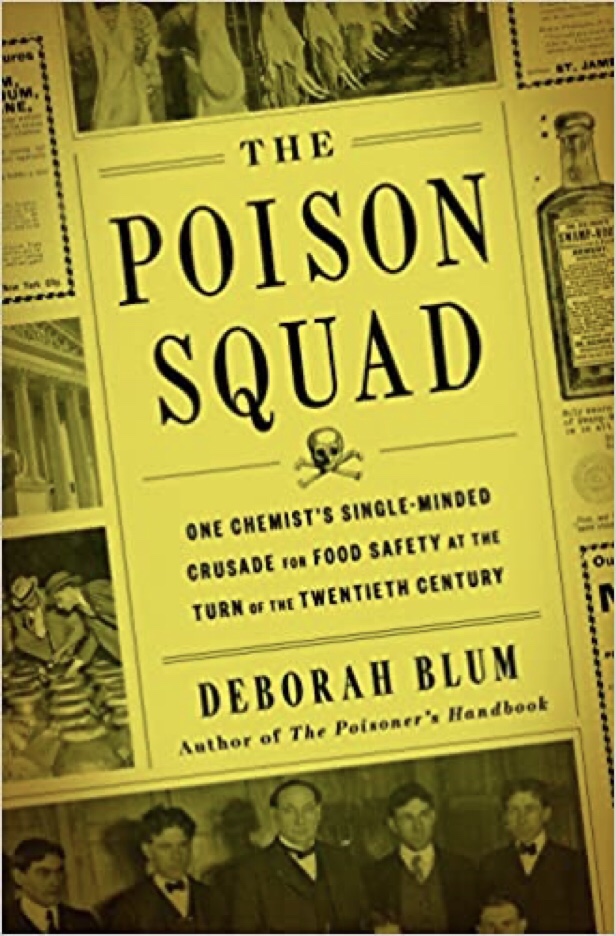
I have not included in the pages count the very helpful ten pages Cast of Characters that the author provided to guide the reader through this detailed documentation of an interesting aspect of American history. The title refers to the team headed by the indomitable chemist, Dr. Harvey Washington Wiley, the Chief of the chemistry division at the U.S. Department of Agriculture for many years, starting in 1883. His uncompromising efforts to document, expose, and pass laws to eliminate rampant adulteration of all kinds of foods, with toxic additives made him enemies within all sectors of the corrupt food and beverage industry. Spoiled beef was embalmed with formaldehyde, gypsum and rock dust was added to flour, arsenic, copper sulphate, and Borax was used to disguise rotten foods, ground up insects with coal tar dyes containing benzene were sold as jams and corn sugars and toxic dyes were sold as maple syrup or honey. Lab ethanol with colouring agents was sold as bourbon. “Coffee” even as beans was sold without any ingredients from coffee plants, with unknown plant ingredients carefully made to look like coffee beans. Thousands of children died from drinking spoiled milk preserved with formaldehyde. Copper sulphate was added to make vegetables look greener and copper sulphites to disguise rotting vegetables. First generation CocaCola contained cocaine, alcohol, and salicylic acid.
The bureaucratic infighting, lobbying, backstabbing and Congressional gridlock that Wiley encountered meant that the first flawed Pure Food and Drug Act was only passed in 1906 and was only sporadically enforced. Dirty tricks such as anonymous letters to editors containing ad hominem slurs and lies abounded. But Wiley also wrote prolifically and spoke to the public eloquently and frequently, engaged with some allies in the food industry such as H.J. Heinz, and groups such as the suffragettes, and conducted what must have been one of the first double blind controlled trials using volunteer civil servants to assess the safety of various additives, first testing Borax. And his cause was boosted by Upton Sinclair’s graphic description of filthy conditions in Chicago meat packing plants in his novel The Jungle.
The cosmetics and patent medicine industries were virtually free of regulation in that era and their ingredients and marketing ploys in many ways are even now akin to those used earlier by the food industry. The latter used patented meaningless alluring names such as Freezine and Preserverine to disguise what they were promoting. We are exposed to Genacol’s Aminolock and Olay’s Regeneris hand rejuvenation instead. Some marketing gimmicks never change.
The much improved Food, Drug and Cosmetics Act leading to the creation of the FDA was only passed in 1938, after Wiley had died. I note here that two food additives that he was concerned about, sodium benzoate used as a preservative and in pickling and saccharin an artificial sweetener are still extensively used. Have they been proven to be safe or does the old Scottish verdict ‘Guilt not proven still apply. At least the labelling improvements will tell you when they are there. And we can be sure what it is if it is called bourbon.
The documentation is extensive and scholarly, but dry and very American-centric. Other country’s regulation of their food industries is mentioned only as it impacted trade with the U.S. All countries have undoubtedly come a long way in improving the safety of their food supplies in the last century or more, but have we gone far enough or gone to far? I can’t answer that question.
This book may be of most value to nutritionists and those working in the food industry, and perhaps cautious grocery shoppers. If I learned anything from it, it is to be ever more skeptical of marketing ploys and to read labels carefully.
Thanks,
Andra.

 The Passionate Reader