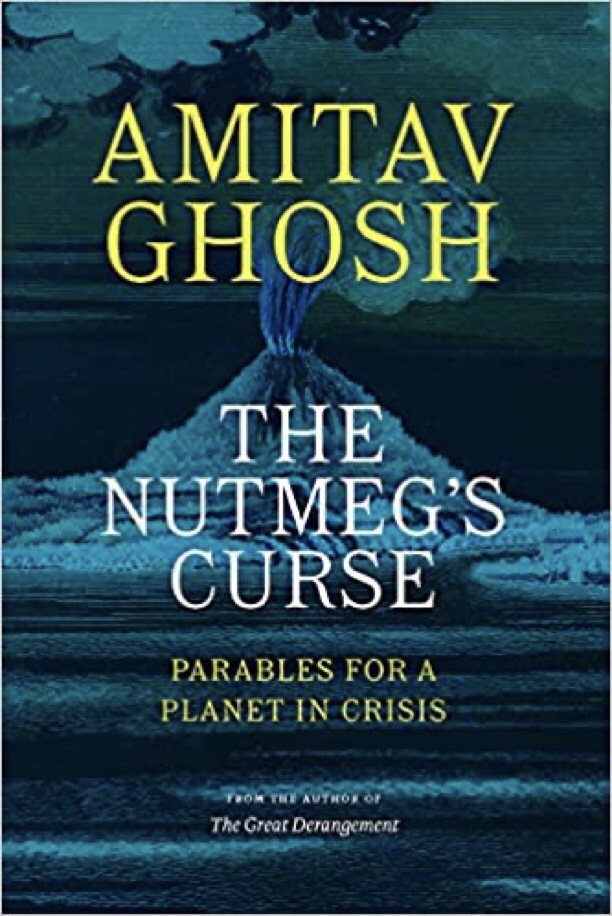
This is a well-researched (34 pages of Notes, a 28 page Bibliography, and a 13 page Index) antiestablishment polemic screed by a Brooklyn-based Indian expat. It provides many nuggets of interesting information and a rare perspective on the perils facing our species and our planet. The title is a reference to the world’s only source of nutmeg in the 1600s, the remote Banda or Lonthor island in what is now called Indonesia, where, in 1621, the capitalists of the Dutch East Indian Company slaughtered the natives to take control of the spice trade. By extrapolation, all of earth’s resources are seen as cursed objects if exploited, to be avoided or at least carefully preserved and replenished. Renaming of cities and countries is seen as colonial linguistic means of burying meaning and reinventing history, supporting imperial European exploitation of resources in the broadest sense including that of human labour.
The nineteen chapters are largely separate essays that can each be read and understood without reference to others, and some are much more interesting and informative than others. In Monstrous Gaia, James Lovelock’s view of earth as an active vital force imbued with purpose, communication skills, and even sentience is explored fully, and contrasted with the capitalist extractive view of earth as a resource to be exploited by a uniquely privileged species.
In Father of All Things, the role of the military, particularly that of the U.S., in perpetuating the status quo and contributing to the climate crisis is exposed with startling troublesome data. He claims that the U.S. military consumed approximately 25 billion tons of fuel per year in the 1990s, undoubtedly higher now-while being deployed largely to protect the sources and shipping lanes of fossil fuel tankers. This does not include fossil fuel use in the production of military hardware. And the military use of fossil fuels is specifically excluded from calculations of reductions of carbon emissions promised in climate agreements. “The predicament of the U.S. Department of Defence is a refraction of the quandary that now confronts the world’s status quo powers…. How do you reduce the fossil fuel consumption of a gargantuan military machine that exists largely to act as a ‘delivery service’ for hydrocarbons?”
In “The Falling Sky” Ghosh expands on the connectedness view of earth in Monstrous Gaia, and the views of aboriginals everywhere of earth as a living vital force needing preservation and protection. He embraces the mysticism of stones, rivers, and flora and fauna as entities that are endowed with independent volition, can be related to, communicating with us, holding the spirits of ancestors, etc. He notes that “It is perhaps impossible to regain an intuitive feeling for the Earth’s vitality once it has been lost; or if it has been suppressed through education and indoctrination.” With western indoctrination and education as a scientist, I can attest to the truth of that statement as I tried and failed to understand the bizarre, psychedelic-powered visions of the world of the Brazilian shaman Davi Kopenawa and other shamans around the world whom Ghosh admires. I seldom talk to rivers, rocks or trees, even those I love.
The tone of this book is entirely negative as the author heaps equal scorn on almost all isms, including capitalism, Marxism, imperialism, colonialism, consumerism, and even some environmentalism- and all religious isms except worship of Mother Earth, which he calls vitalism and shamanism. While I learned a lot and generally appreciate iconoclastic attacks on what the late John Kenneth Galbraith dubbed ‘conventional wisdom’ I cannot recommend this humourless book with its pessimistic outlook for our future for the general public.
Thanks,
The New Yorker

 The Passionate Reader