Before starting into this one, on someone’s recommendation, I read part of Johnathan Franzen’s new novel Crossroads. But after less than 100 pages of 580, I abandoned it and returned it to the library. It is the first of a proposed trilogy and although it flows smoothly, I found what I read a bit unimaginative and could not reconcile myself to reading this, perhaps for the rest of my life, particularly when this little gem was sitting there beside me. Kudos to anyone who wades through Crossroads.
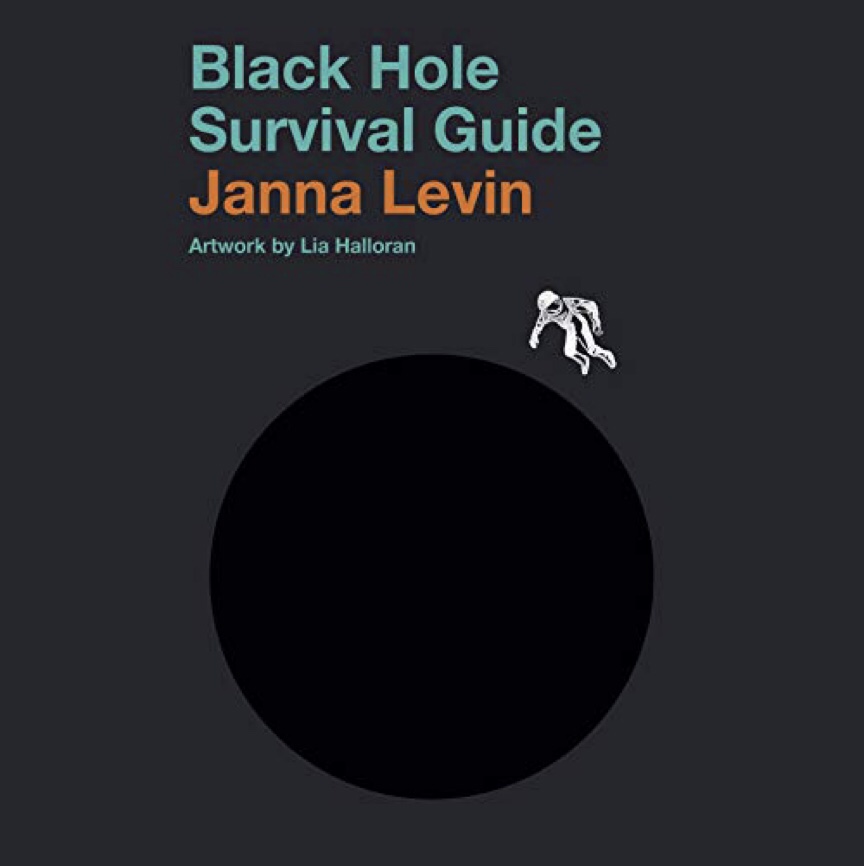
This little book (what distinguishes a book from a booklet?) is also part of a series, the latest by an American astrophysicist and professor at Barnard College, all of them about black holes.
Time becomes dilated and space is warped as you approach the event horizon on the edge of a black hole then fuse completely as you cross it toward the singularity of nothingness, or into a parallel universe within the black hole. (Astrophysicists debate which of these alternatives scenarios fit the data.)
Comparatives, such as before/after, above/below, heavy/light, and place and dimensions become meaningless words to those steeped in the lingo and mathematics of astrophysicists. Black holes are nothing, yet they have mass, spin, and charge and gobble up stars, galaxies- and visitors. She could have added that they apparently have measurable dimensions. And if you, the intrepid visitor, cross the event horizon where the escape velocity exceeds the speed of light, the information you glean (qubits in astrophysics lingo) may or may not escape in the form of Hawking radiation. Perhaps it is our linguistic limitations that make such paradoxes seem foreign and difficult to understand. The Heisenberg Uncertainty Principle, (which would logically lead to the conclusion that even interstellar space cannot be entirely free of matter) is likened to the difference between a lone musical note and one within a chord.
The existence of black holes was ‘proven’ with the aid of a huge radio telescope on April 9, 2019, although the resulting image is partly white.
The major remaining big efforts in this rarified field are to reconcile relativity with quantum mechanics and Hawking radiation from black holes. And Hawking radiation comes as monogamous entangled quantum pairs (those qubits) that can be separated and then communicate information over vast distances faster than the speed of light because they are complementary like the two parts of a broken wishbone. How black holes which supposedly are nothing and from which nothing can escape transmit Hawking radiation Is a paradox which left me confused; I doubt that I was the only one.
I recall how puzzled I was as a child on first learning that the largest volume within of all atoms is a nothingness, a void. But such facts that challenge our intuitions are the mainstay of most physical and chemical sciences and are exemplified best in astrophysics- and most ably explained in this beautiful little book. Although I have read numerous books on relativity and cosmology, I cannot claim even a rudimentary working understanding of them; reading this book provided a useful upgrade to my understanding. I would also need a major upgrade to my mathematics schooling to clear the fog further.
The author’s infectious enthusiasm for her subject overflows into her writing and off the page on to the reader. And the reader’s imagined attempt to travel to the event horizon and beyond of any one of billions of supermassive black holes in the known universe is like a plot line in a wild sci-fi novel.
I greatly enjoyed reading this book; confusing in places, enlightening in others, and literally otherworldly, it is stuffed with great analogies, paradoxes, and apparent contradictions.
Thanks,
Andra, via Cratejoy.

 The Passionate Reader