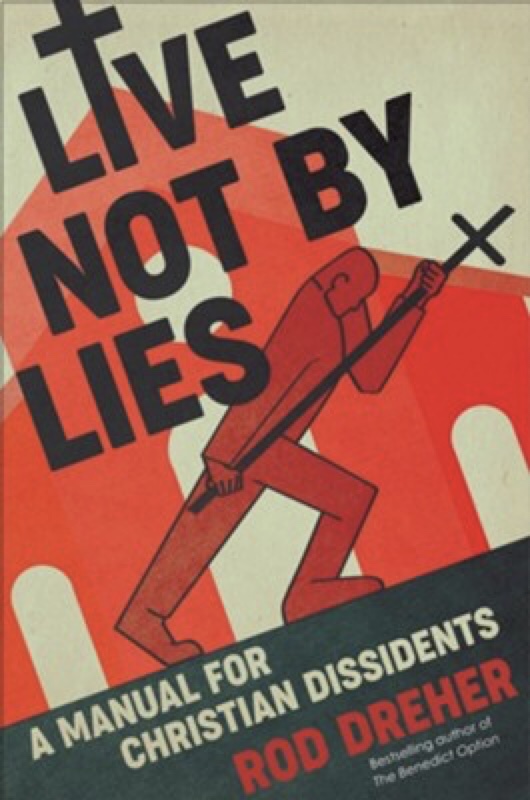
Although I now often abandon books that I am not enjoying reading or learning anything useful from, I occasionally read ones that I know in advance that I will not like. I think it is important to once in a while leave my echo chamber, or as some prefer my ‘thought bubble’, and read books written by people with very different religious, economic, and political viewpoints from my own and with different outlooks on life. In part this is to critique what I may find as faulty logic but more importantly it is to try to understand where they are coming from. Such was the reason for my reading of George Wills’ The Conservative Sensibility which I reviewed on February 20, 2020 and this one- and the Koran, which I have read but will never review, as I still value having my head attached to my body.
The title of this rant by a devout member of the Eastern Orthodox Church after abandoning Catholicism comes from a warning by the exiled Russian dissident Aleksander Solzhenitsyn. In Part 1, Understanding Soft Totalitarianism, other writers, cultural observers, and thinkers whom I admire, such as Eric Blair (better known as George Orwell), Hannah Arendt, Aldous Huxley, Edward Snowden, and Robert Putnam (he of Bowling Alone fame), are quoted extensively to bolster the argument that ‘Soft Totalitarianism’ created by leftists, intolerant agnostics, Social Justice Warriors (SJWs), and the thought police of the ‘woke’ culture, dedicated to the ‘Myth of Progress’, are threatening to our democracies and freedoms. According to the introduction, visionary persecuted ex-Soviet immigrants are uniquely capable of seeing these trends developing in America. There is certainly an element of truth to these assertions and the suppression of free speech on campuses and the dramatic recent increase in political polarization, particularly in the U.S., are frightening trends.
The documentation of the extent of the intrusion of the surveillance state, aided by both corporate and government agencies is truly alarming to those of us who value privacy. However there is no definition provided of either freedom or liberty, and no discussion of the capacity of the conservative right to wield equally abusive power over whole populations. Who has the freedom and right to authorize Texans to spy on their fellow citizens and report those seeking abortions for monetary rewards? Apparently, a right-wing conservative Catholic governor does. There is no mention of the extreme intolerances and cruelty meted out in the name of religion in the past, from the Crusades to the Salem witch trials, even the invasion of Ukraine by a devout Putin, in part to unite the quarrelling Russian and Ukrainian Orthodox churches, and from a different religious zealotry, 9/11. The truckers and anarchists recently occupying downtown Ottawa, desecrating national monuments and denying residents there the basic right to enjoy peace and quiet or even open their shops, invoked ‘freedom’ as the reason for their illegal activities. Whose freedom?
In the six chapter Part 2, which is loaded with dogmatic advice on How to Live in Truth, in one titled Families Are Resistance Cells, the author praises the rigid parental indoctrination of young children in their own one true religion that he observes in a persecuted Czech Catholic family. But this widespread practice is viewed by Richard Dawkins as a form of child abuse, restricting the child’s later capacity for independent thinking, ensuring that they develop a myopic world view. In The Gift of Suffering, the need for suffering as a test of one’s true faith is backed by quotes from Dostoyevsky and one from Soren Kierkegaard that I suspect is used out of context. The stoicism of the author’s flavour of Christianity seems more akin to the dour one adopted by Malcolm Muggeridge late in life than the tolerant, almost cavalier, forgiving Catholicism of Graham Greene. The advise for Western Christians to start forming secret underground cells now seems a little alarmist or at least premature to me. The worst threats in western democracies to religious freedoms that I am aware of are Donald Trump’s failed attempt to prohibit Muslim immigration to America and Quebec’s more successful but deplorable (in my opinion) prohibition of the wearing of religious symbols by public servants.
There is throughout this informative book a vague undertone of paranoia on the part of the author and his apparently beleaguered righteous fellow believers. They seem to feel, and even to welcome and revel in a perverse victim mentality that effectively shuts out any consideration of dissenting opinions as just part of the evil societal trends they are up against with their unique knowledge of The Truth, as revealed only to them by their God. The quoted dissident statement that “when a people become accustomed to living in lies, shunning taboo writers, and conforming to the official story, it deforms their way of thinking” cuts both ways.
I appreciated reading this book more than I thought I would when I chose it and perhaps more than my harsh take on it above would suggest. There is a need to take seriously some of the warnings from persecuted ex-Soviets that he interviews exclusively. (Ironically, he reports on no interviews with American church leaders whom he is claiming to write on behalf of.) But take those warnings with more than a grain of salt. The the lessons I learned were certainly not the ones the author wishes to impart to readers.

 The Passionate Reader