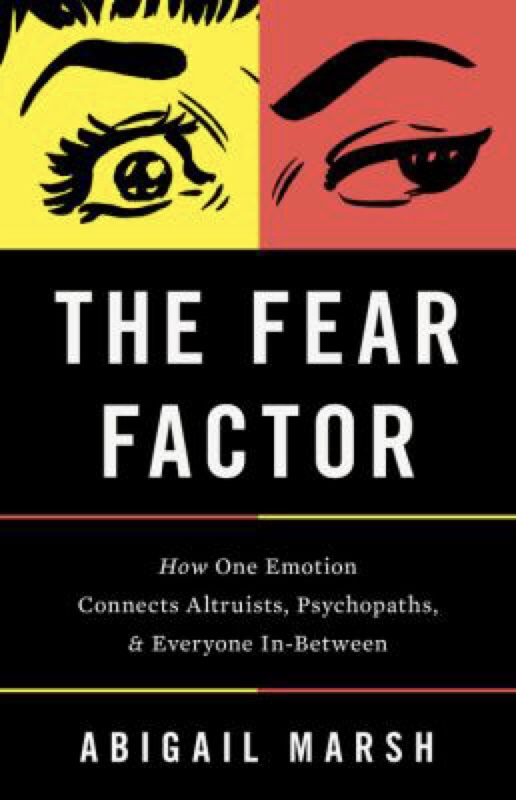
I have long been interested in neuroscience, so when my dear friend and former colleague at Western, Al Driedger, posted an article about mirror neurones, those clusters of brain tissue that facilitate development of empathy, at least in humans and bonobos, on his Brianworms site, which covers anything and everything scientific, Iasked him if he knew of any studies of them in psychopaths. He referred me to this book by a Georgetown professor of psychology and neuroscience.
After personally experiencing both acts of incredible altruism and of satanic cruelty at the hands of complete strangers, she switched her studies as an undergraduate in medicine to the world of psychology to research these extremes of human behaviour. She reviews ad nauseum the familiar problematic studies of Stanley Milgram at Yale and Philip Zimbaldi at Stanford demonstrating the ease of inducing cruel behaviour in some but not all normal volunteers in experimental situations given some incentives and authorization (and authority in the form of a uniform in the later case). We did not need these studies as real world examples such the unapologetic defence raised by Adolf Eichman at his Jerusalem trial already existed. It is a tribute to the increased oversight by Institutional Review Boards now that no such questionable studies would now be allowed on any campus in Western Europe or North America. Yet such cruelties, and worse, persist with the help of seemingly unsupervised government agencies such as the CIA.
In later reflections on theses and other studies, however, Marsh points out that unlike Eichman, many participants in these studies expressed anxiety and remorse about the doling out of what they thought was torture to strangers. Many volunteers distressed by watching others being tortured even volunteered to take their place. Thus, sadism and altruism are shown to both be alive and well. Generic and environmental factors influencing where people fall in this spectrum are then explored with a review of twin and adoption studies. Distinctions are made between psychopathy and psychosis, and reactive aggression and proactive aggression, the latter being characteristic of psychopaths and much more determined by genetic influences.
After reviewing the arbitrary, often-changing and subjective points-based DSM criteria that are nevertheless necessary for researching psychopathy and for developing research and treatment guidelines, she moves on to the studies showing that teens with psychopathic tendencies lack the ability to experience fear or identify it in others. This is associated with distinctly smaller and less metabolically active deep brain structures called amygdalae that may be the site of those mirror neutrons, on functional magnetic resonance imaging, although she never mentions ‘mirror neurones’ as such. Thus my question to Al was partially answered. And these anatomical abnormalities in turn are largely genetically determined, and not just correlated with psychopathic behaviour, but appear to be causative in that they are absent in those reactive violence-prone sensitive individuals who nevertheless experience fear, identify it in others, and express remorse and guilt.
I seemed to attract psychopaths in my professional past. I vividly recall one very charming rogue who had the courtesy to call to cancel his upcoming appointment without rebooking, only to hear his name the next day in the news-a Canada-wide warrant had been issued for his arrest, for attempted murder if I recall correctly.
The author devotes 30 pages to review the evolution of mothering care and alloparenting with the species variability from loggerhead turtles with no maternal behavior whatsoever to some mammalian species with maternal behaviour only for their biologic progeny (sheep) to rats with maternal care for other rat’s offspring, to dogs who adopt and fiercely protect babies of other species, to humans like the author who care deeply about even abandoned baby turtles on a Florida beach. I was reminded of my summer of care and feeding of a young Great Horned owlet that my brother and I had unintentionally scared out of the nest, raising her, feeding her and giving her aviation lessons from greater and greater heights until she took off from the peak of the barn roof, over the horizon, never to be seen again, leaving us saddened.
Evolution and multiple unique functions of oxytocin in modulating behaviour in mammals and the differences in altruistic anonymous kidney donors’ and psychopaths’ brain anatomy and physiology come next. The dedicated altruists, acting on instinctive compassion are shown to have larger and more metabolically active right amygdalae than average. What goes on in the left amygdalae?
The last two chapters largely forsake the detailed scientific brain imaging and chemistry studies doled out earlier to discuss and recommend possible ways of increasing individual and group altruism- no less interesting and with great insights, but more nebulous. She quotes two of my favourite writers and thinkers in this section-Stephen Pinker of The Better Angles of our Nature, and the Australian philosopher Peter Singer.
This is a fascinating well-organized and informative book that I greatly enjoyed reading.
Thanks,
Al

 The Passionate Reader