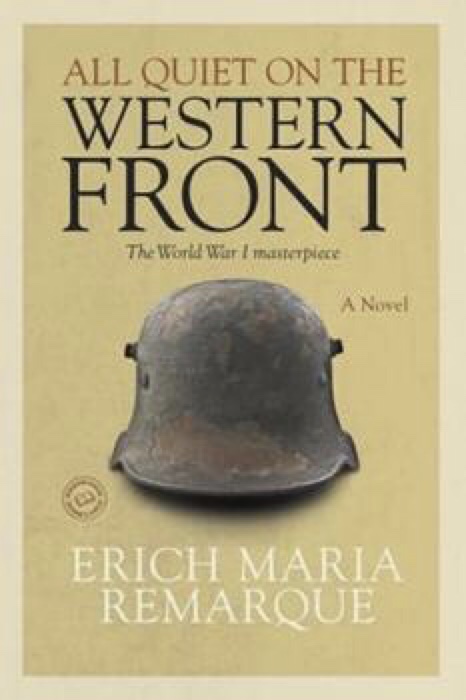
I would never have read this novel were it not to be discussed at our book club next month. Narrated in the first person singular by a fictional 18 year old German recruit, it is set on the front line at an unspecified site somewhere in France in 1917-18, as the Allies were slowly overpowering the German forces. It seems, in part, to be based on the author’s real-life experiences in those trenches where he was wounded in 1917.
There is heart-wrenching pathos as the narrator tries to console his comrade, the dying Franz Kemmerich with what they both know to be lies. Discussions of battles with rats and lice and the disadvantages of killing the enemy with bayonets vs spades only covey a small part of the horrors of war. One after another of his compatriots dies a horrible death from wounds, infections or exposure, while almost starving and dreaming of going home and courting girls.
On leave, the narrator discovers that his mother is bedridden with cancer and that he will never see her again after he returns to the front. The observation, first attributed to Aeschylus that “In war, the first casualty is the truth” is borne out in many places, most notably when the narrator swears to the mother of one of his fallen comrades that her son died instantly and painlessly. The observations made by many that surviving soldiers can never discuss with civilians the horrors they have seen and experienced in battle holds true here as the lies about the conditions at the front pile up. Perhaps the biggest lie of all is the German high command report late in the war that the title is based on.
Some of the reflections about war revealed in the narrator’s musings about captured enemy soldiers are truly profound: “A word of command has made these silent figures into our enemies. A word of command might make them into our friends. At some table some person whom none of us knows signs a document and then for years together that very crime on which the world’s most severe condemnation and severest penalty falls, becomes our highest aim….Any noncommissioned officer is more of an enemy to a recruit, any schoolmaster to a student, than they are to us. And yet we would shoot at them again and they at us if they were free.”
The writing flows smoothly in short pithy sentences and phrases. Although written from a German perspective, the narrative is not biased and is loaded with universal truths. Even though the descriptions of the horrors of war are the most graphic of any that I have ever read, I found the story magnetically engaging and enjoyed reading it. I will long remember it. But I have no desire to see the movie adaptation of 1930 or the TV one of 1979.

 The Passionate Reader