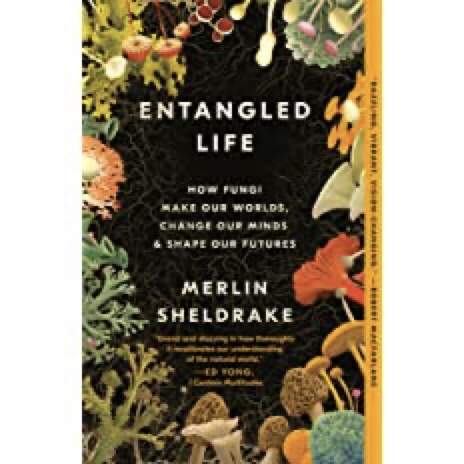
Pursuing somewhat similar lines of research as that which Suzanne Simard details in her Finding the Mother Tree but in different ecosystems around the world, this British mycologist provides a masterpiece of science that is bound to change the way you think about fungi and a lot of other things. It shines a wider light and more global perspective on them, ourselves, and all living matter rather than the sharp focus on their relationship to trees in Finding the Mother Tree.
Wide-ranging is too narrow a description of topics Sheldrake covers. From our philosophical definitions of the self, consciousness, brains, thinking, decision-making, bargaining, and intelligence, and the dualism of mind and body, he challenges readers to reconsider what they believe. Lichens composed of interdependent fungi, algae and some bacteria and even viruses invite reconsideration of the definition of a species and the boundaries of the self.
The list of astounding abilities of fungi cited is long. Here are a few. Kerosene fungi thrive in the fuel tanks of airplanes! Fungi are being used commercially to manufacture leather, furniture, clothing, packing and building materials stronger than concrete, from dead wood that otherwise would rot and emit carbon dioxide. Antiviral and antibiotic compounds manufactured by fungi include penicillin and are used to kill the virus largely responsible for bee colony collapse disorder. Many fungi can alter their metabolism to break down toxins we send into our environment, including plastics, cigarette butts, petroleum products, pesticides, and herbicides like glyphosate (Roundup). They appear to bargain and negotiate with plants in what by analogy looks like buying and selling on a stock exchange. They may have been involved in the origin of life on earth via panspermia of spores from other planets. Some destroy the back half of cicadas, infect the remaining body and drop spores as the cicadas continue to fly around. They have systems of electrical signalling that somewhat resemble brain messaging. By producing alcohol and the universally available hallucinogen psilocybin they can kill or control the behaviour of insects and historically have altered human history and cultures. These are just a few of the surprising facts presented. Yet most people think of fungi only as mushrooms from grocery stores, as nuisances that spring up overnight on the lawn, or as the agents for domesticated decomposition of sugars for making alcohol, bread and cheese and the rotting of wood structures, if they think of them at all.
“Imagine the puzzlement of an extraterrestrial anthropologist who discovered after decades of studying modern humanity that we had something called the Internet. Its a bit like that for modern ecologists.”
Sheldrake cites another astonishing finding that is discussed in relation to the navigational abilities of fungi. Flatworms who have learned to navigate a maze, but have then had their heads severed regrow a new head and can still “remember” how to navigate the maze. He asks more questions about fungi than he answers, but his infectious enthusiasm for learning more about them will rub off on the reader of this book. He seems to recognize the boundaries of our linguistic descriptions in characterizing their complexity.
Charles Darwin is quoted as defining intelligence as the ability to adapt to the environment so as to ensure survival. By this perhaps flawed definition, Homo sapiens is a far less intelligent species than most fungi.
I have only one minor criticism although I may well have missed other problems. He cites the discredited Canadian psychiatrist Abram Hoffer as one of many experts he relies on for information, but I am not sure if the information attributed to him is problematic or not.
The only reservation I have in recommending this eye-opening book for everyone is that it may be a bit of a struggle for some with no background science education, but if so, it would still be a worthwhile struggle. I rate it as one of the best science treatises I have ever read, if not the absolute best.
⭐️⭐️⭐️⭐️⭐️
Thanks, AAD, my s friend and science guru.

 The Passionate Reader