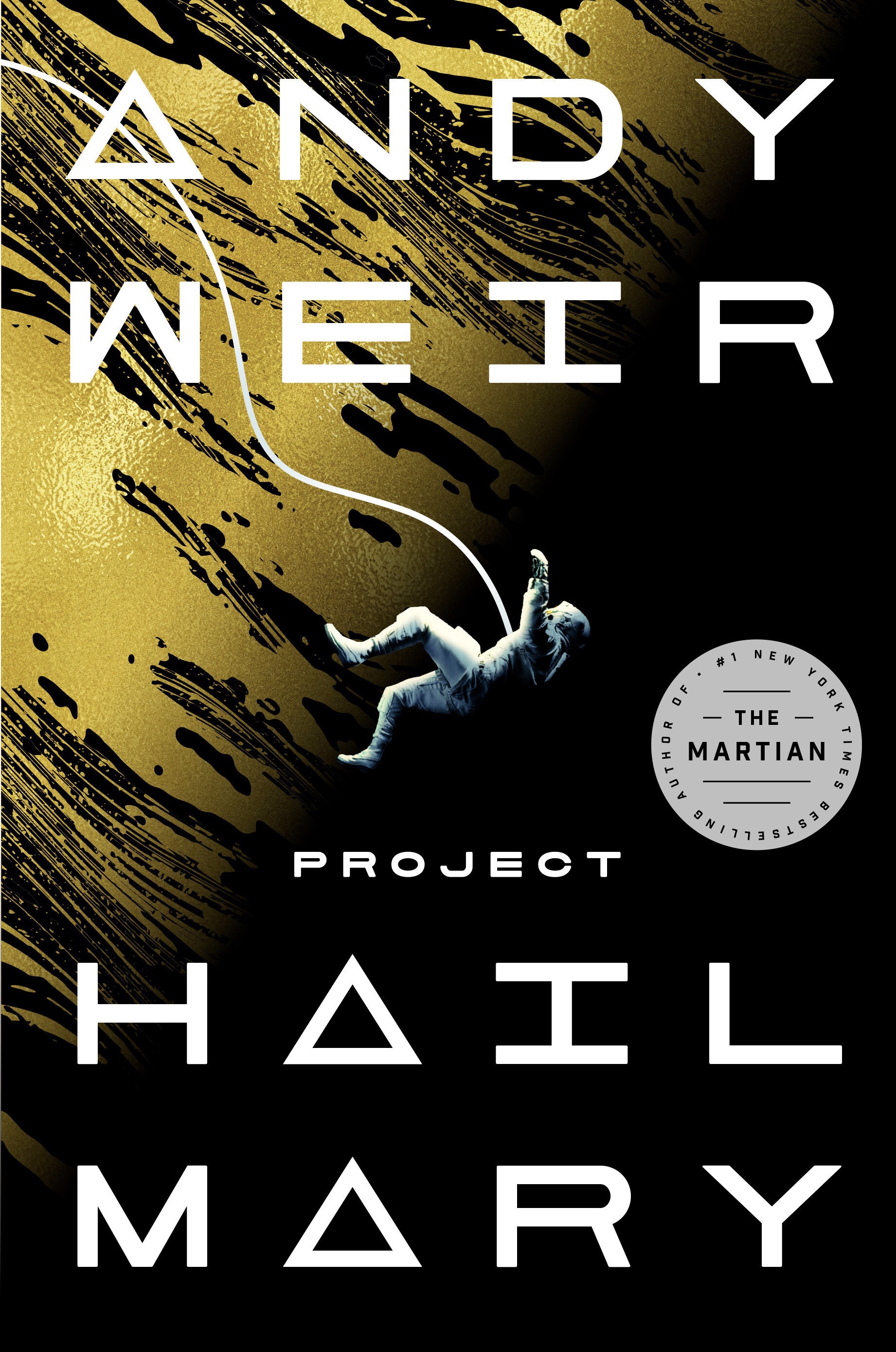
I seldom read any science fiction, but recognizing that much of what would fit into that genre 30 or 40 years ago is now phenomena that we take for granted, (think of Google searches or IVF), I decided to have a go at this one recommended by a friend.
The protagonist, Ryland Grace a British middle school science teacher, comes out of a coma in a space ship named Hail Mary in some foreign solar system. A mysterious set of microorganisms called astrophage (never written in the plural) are eating solar energy at an astronomical rate causing the sun to cool rapidly, endangering not just life on earth, but the existence of the planet. In alternating first person singular narrative sections he is either on earth in captivity undergoing compulsory training or on the Hail Mary space ship on a one-way trip to Tau ceti to determine why it seems immune to infection with astrophage. He alone survives the trip but meets a peculiar spaceship from 40-Eridani with an intelligent five-armed sole pilot that he painstakingly learns to communicate with, using only musical notes without lyrics, and navigating by echolocation. As their friendship deepens, they realize that they are both on the same mission, i.e to save their home planets from complete destruction by the astrophage.
There is a lot of hocus pocus “science” which is the hallmark of science fiction, and the plot with encounters with alien life forms and grandiose themes of saving humankind from certain annihilation must have some broad appeal. In this one the plot is rather ingenious with lots of unpredictable twists and also incorporates many principles of relativity, true science, time warps, and the theory of panspermia to account for the evolution of life on multiple planets.
Much of the science is beyond my ability to understand (even the mechanics of Foucault’s pendulum and Fortran data conversion) or to refute, but some basic impossibilities stand out. For example, Ryland is able to carry on a long conversation even with an endotracheal tube in his trachea.
There are some great insights such as “Broadly speaking, the human brain is a collection of software hacks compiled into a single, somehow-functional unit. Each “feature” was added as a random mutation that solved some specific problem to increase our odds of survival.”
My limited capacity to suspend belief in the possible makes it difficult for me to enjoy this tale, even though I admire the expansive imagination of the author.
Having renewed and reaffirmed my dislike for the sci-fi genre with this read, I will avoid it for my remaining years without feeling guilty.
⭐️
Thanks, Allan M

 The Passionate Reader