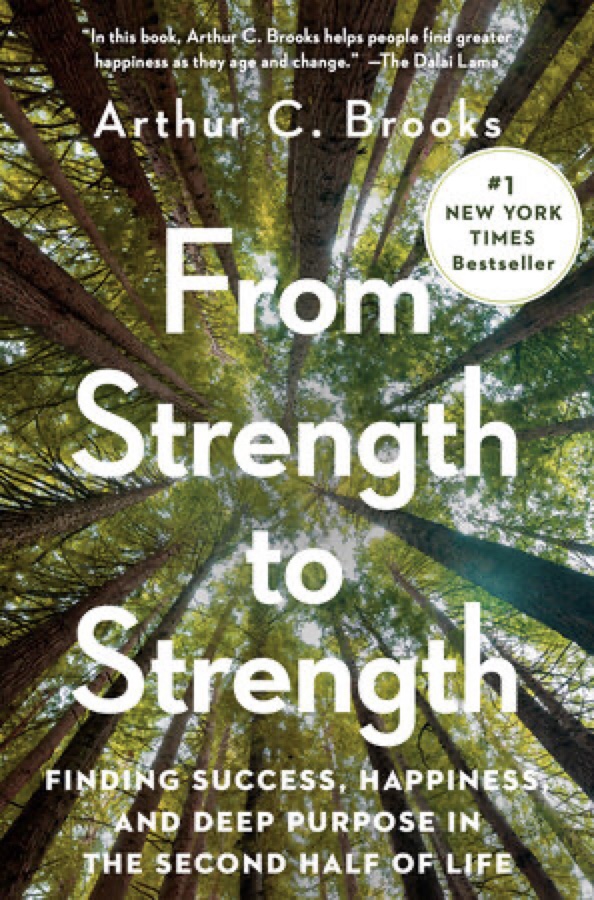
My daughter must think that I am in need of advice on how to live my life after retirement, and perhaps she is right. But I have a deep-seated distrust of self-help books, with a firm, perhaps misplaced, belief that I alone am best qualified to determine what is most likely to make me happy, productive and useful at any and all ages, so I approached this book she gave me with a fair degree of scepticism.That scepticism was strengthened when I realized that the author was until recently the president of the influential conservative American Enterprise Institute, a Washington think tank funded to the tune of many millions by corporate America, including Exxon Mobile and the billionaire, Charles Koch, and he is still listed as on their staff. There is something ironic about a rich professional in that capacity advocating the abandonment of the striving corporate culture of always acquiring more material goods, money, power, or prestige. As an aside, I am not sure if nonprofit think tanks, like America’s Heritage Foundation or Canada’s Fraser Institute are a net positive influence on societies, but, in the age of mass misinformation, one needs to know their background and funding to interpret their prodigious output of data and opinions accurately.
This Washington,D.C. social scientist and writer addresses the common problem of how to maintain happiness, a sense of purpose, relevance, and usefulness to society after you have passed your best before date, or the time when your skills in your primary occupation begin to decline, which he claims comes earlier than most people believe, particularly for high achievers.
The whole premise of this advice is based on the 60 year old distinctions made by the psychologist Raymond Cattell between fluid intelligence used in early careers and crystalline intelligence after the inevitable decline of those, and his resultant fuzzy two curve model of the trajectory of everyone’s life, as though everyone’s life Is neatly divided into two discrete time frames each with exclusive priorities and needs. Where do many modern workers who careen through several different careers fit into this model?
I don’t want to disparage everything this author has to say and he dispenses a lot of good advice that would have been helpful to me years ago, when I struggled with the doldrums that commonly plague the adjustment to retirement. What valuable advice there is would seem to me to apply mainly to executive and professional workers and not to, for example, Newfoundland fishermen, African subsistence farmers or Asian factory workers who have little choice about the trajectory of their lives. But much of it is simple common sense which is apparently in short supply and may be more abundant in those Newfoundland fishermen than in corporate CEOs and striving professionals. And if someone deliberately decides to follow Dylan Thomas’s advice to “Rage, rage against the dying of the light”, to slide into the grave shouting “what a helluva ride” rather than even trying to adjust to inevitable limitations of aging, should they be judged harshly? There is no one-size-fits-all model of what constitutes a life well lived.
The chapter on spirituality is doubly confusing, combining the author’s rigid Catholicism with an admiration for Tibetan Buddhism, meditation, and an Indian Hindu guru’s version of ashram which divides life stages into four phases, rather than two. There is no mention of the horrors, incredible cruelty, and the millions who have died over many centuries because of religious zealotry, nor the religious intolerance currently ripping Indian society apart.
This book illustrates almost everything I dislike about the self-help genre, not only in literature but on social media and television (think Dr. Oz) and in the growing industry of self-appointed life coaching: far reaching generalizations from temporally limited social science surveys of populations that may not be representative, artificial distinctions, foregone conclusions that fit the writer’s biases, trite aphorisms, uncritical acceptance of unduplicated and possibly biased studies and surveys, endless psychobabble, and, in spite of proclaimed humility, a self-appointed supposition that the author knows how everyone else should live their lives, i.e just like he does.
⭐️
Thanks, Andra

 The Passionate Reader