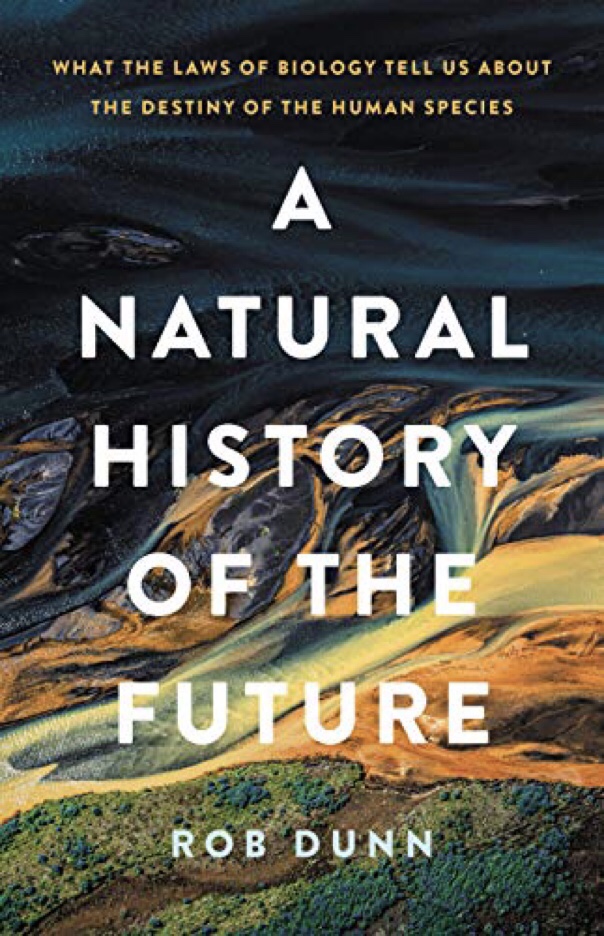
After reading a review in The Economist, I borrowed the 680 page Legacy of Violence by Caroline Elkins, a history of the British Empire, from the library. But after the first 50 pages, I found it to be the perfect cure for insomnia, a condition I have never experienced. Ergo, I returned it and downloaded the audio edition of this book instead. At least this is not entirely about the history of human cruelty to other humans. The North Carolina State University evolutionary biologist speculates about the effects of all the damage we have wrought to the planet and other life forms and what will emerge in the way of new life forms as a result.
The topics discussed are wide-ranging from the Mesopotamian and biblical stories of floods (Noah as the ultimate conservationist) to the rate of mutation of fast reproducing microbes and the demise of rubber production because rubber trees may become extinct within a generation.
Millions of species will have to move to find new islands of suitable ecology for them to survive and many won’t be able to. The concepts of limited niches for all life forms and of conservation corridors that we can somewhat facilitate as those change are hardly new. But the urban corridors are of limited value for many immobile species. We inadvertently provide transit corridors for smaller species such as microbes that can move with us in cars, trains and planes.
Some of the so called laws of nature cited seem to be just common sense restated. It is hardly new to point out that diversity in crops with evenly distributed portfolios of different plants and crop rotations are good for stabilizing the environment. The ‘law’ of escape from predators may express a fact of natural evolution, but we are often ignorant about what eats what.The hour-long chapter on bird adaptations is reminiscent of Jennifer Ackerman’s The Genius of Birds. The long list of diseases attributed to birthing by Caesarian section and the resulting lack of maternal microbial transfer seems exaggerated to me and may conflate correlation with causation. There are stretched analogies such as that of antibiotic resistance in E. coli bacteria and broken levees on the Mississippi. Seeding humans with microbes that we need from seed banks and knowledge of our unique genomes would seem to me to be risky and far-fetched and hardly compatible with leaving nature undisturbed.
The audio book is limited in that readers obviously lack access to the charts and graphs that the author refers to. The very expanded tree of life that is available as a PDF document includes some very odd organisms; we, and our hominid relatives are out on a very small vulnerable twig on that tree. “Our end is far nearer than the end of nature.” (The end of nature would seem to me to be a philosophical imponderable.)
There is a hectoring tone as the author bemoans all the damage we have done and continue to do to nature rather than provide insights into the future as suggested by the title. The narrator’s somewhat monotonous voice must invite many readers to nap as the story continues. Overall, although it provided a fresh perspective and I learned a few bits of new information, I was disappointed with this book.
⭐️⭐️⭐️
Thanks, The Atlantic.

 The Passionate Reader