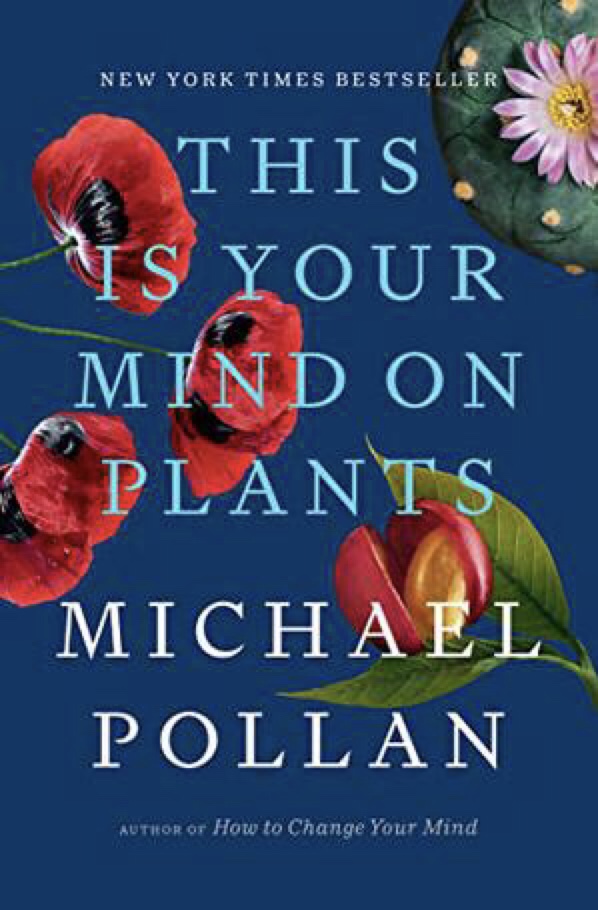
A quote from page 4 of the Introduction provides a hint of what is to come: “Evidently, normal everyday consciousness is not good enough for us humans; we seek to vary, intensify and sometimes transcend it and we have identified a whole collection of molecules in nature that allow us to do that.” Of the dozens of plant-derived mind-altering molecules, he chooses to discuss only three with which he has personal experience, namely opium, caffeine, and mescaline. He doesn’t completely ignore the longstanding love/hate relationship of humans to alcohol, capably discussed in Edward Slingerland’s 2021 book Drunk, and sees similarities between the hypocrisy of the 1990s ‘war on drugs’ and the 1920-33 prohibition laws.
The bulk of the discussion of opium is a reprint of a long article he had published in Harpers in 1996, with an added Prologue, an Epilogue and a section that he had deleted from the original for fear of litigation. A dedicated gardener living in Cornwall, Connecticut and Berkeley, California, he grew a variety of poppies whose seeds yield opium, a mixture of narcotic alkaloids, mostly morphine and codeine, in his garden, the seeds legally obtainable from a variety of seed catalogues. This was just when the Drug Enforcement Agency was ramping up their ‘war on drugs’ after the ‘war on poverty’ and before the ‘war on terror’. When will the U.S. government abandon military analogies to address their social ills? Criminal charges with heavy penalties and long jail terms were handed out to growers of such poppies even though they were bought legally and usually planted purely for their beauty. He notes that this was also the time when the Sackler’s Perdue Pharmacy, with FDA approval, was aggressively promoting their OxyContin with false claims of safety. That lead to the ongoing opioid epidemic that has killed thousands of Americans annually, though no Sackler has been put into prison. Only after the statute of limitations made it impossible to prosecute him, did he admit to a one-time use of the poppy seed extract as a tea which he found to be very bitter and the high not very euphoric and included that experience in this update. But one can still obtain narcotics by extracting them from legally grown poppies or from grocery store culinary seeds. But the rate of arrests for violation of drug laws in the U.S. has barely changed from 1,247713 in 1997 to 1,219,909 in 2019, not all related to narcotics.
The 62 page chapter on caffeine is equally loaded with multiple ironies. The history of how coffee and tea came to rule our daily lives, the exploitation of growers by imperial powers, and the positives and negatives of caffeine use in different cultures are explored in detail. His interview with fellow Berkeley researcher, Matthew Walker who wrote the insightful Why We Sleep is a wake-up call (pardon the pun) to the widespread prevalence of poor sleep quality and quantity in part attributable to the pharmacological effects of caffeine on our brains.
As the effects of his three month self-imposed abstinence from coffee take effect, Pollan notes: “I came to see how integral caffeine is to the knitting of ourselves back together after the fraying of consciousness during sleep.” There is no doubt that caffeine is an addictive drug even to bees that selectively pollinate plants that seductively lace their nectar with caffeine. In a Darwinian world do we or coffee plants benefit more from its addictive properties?
The final section on mescaline was a bit disappointing for me. Although there are reasonably well-controlled trials showing some benefits to the use of LSD and psilocybin in certain psychiatric conditions and addictions, there are none comparing mescaline to a placebo as far as I can tell, although a phase 1 trial is underway in Switzerland. Mescaline is readily available from several cactus species but can only be legally consumed, at least in the U.S., if you are a Native American on a reserve, and a member of the Native American Church, where it is used in sacred rituals. Nevertheless the author consumed it at least twice. He completely avoids discussion of the mechanism of mescaline effects on our brains but describes the effects in detail using woo woo mumbo jumbo spirit-world jargon that left me with a determination to avoid it at all costs. As a life-long scientist, my brain as long been programmed to linear concrete thinking and a world where plants give us advice and see and hear us is too foreign to take seriously.
The writing is scholarly and detailed that kept me fully engaged and I learned a lot. It is also very limited to a United States perspective. I have no idea what the legal status of mescaline or growing opium-producing poppies is in Canada.
⭐️⭐️⭐️⭐️
Thanks, Andra.

 The Passionate Reader